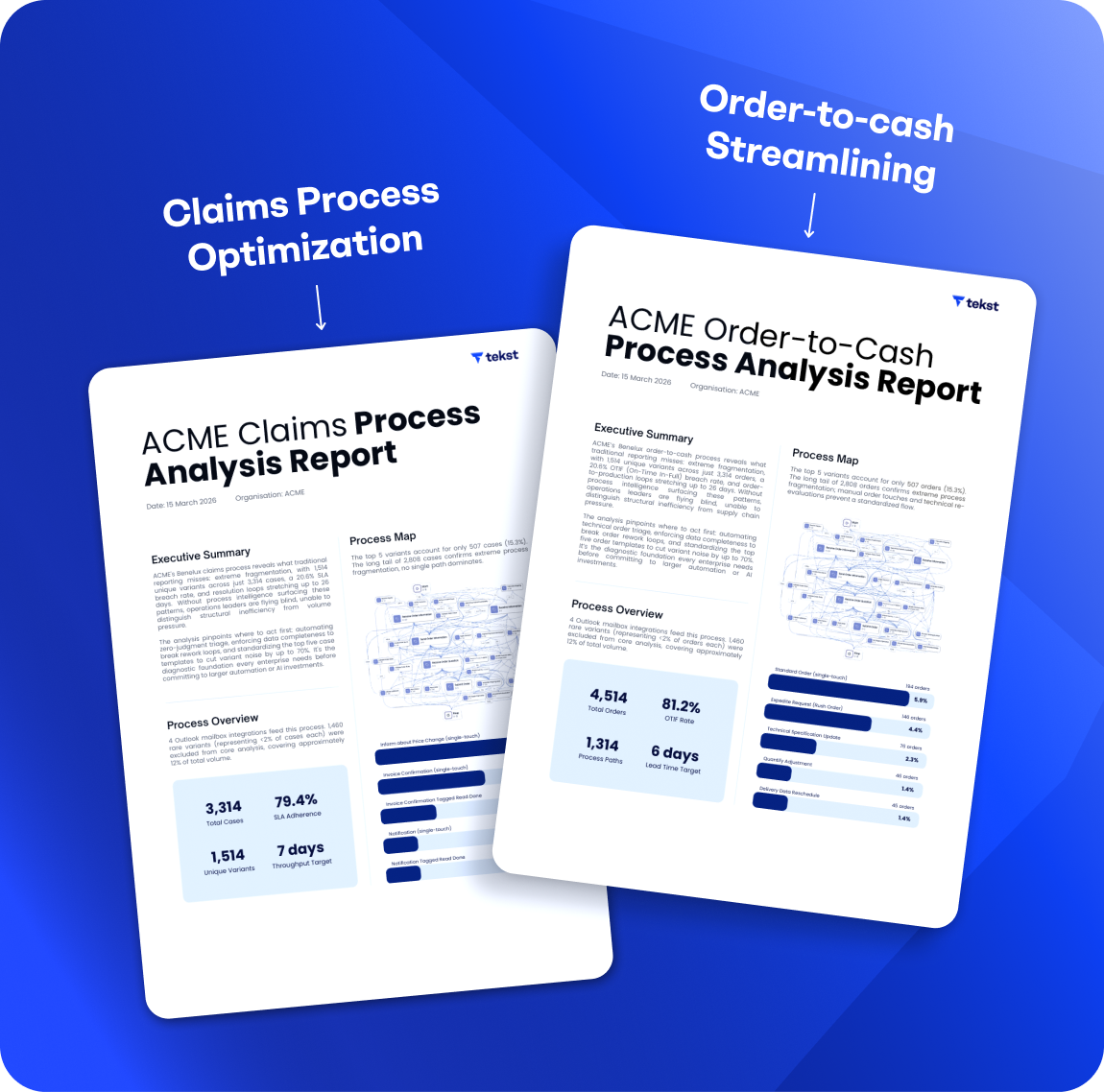
Process fragmentation invisible in SAP
How 3,314 claims and 4,514 orders each produced over 1,300 unique process paths, and why traditional reporting makes this invisible until it becomes a customer complaint.
Everything that happens between your customer's email and your ERP entry is finally visible.
Most breaches do not start in the ERP. They start in the inbox. These audits show exactly where, how long each delay costs, and what fixing the highest-impact bottleneck saves.
Access a FREE Process Intelligence Audit
Not a benchmark. Real audits on real claims and order data, sanitized but not simplified, with specific recommendations and expected savings per fix.
How 3,314 claims and 4,514 orders each produced over 1,300 unique process paths, and why traditional reporting makes this invisible until it becomes a customer complaint.
Every bottleneck mapped with median duration, case volume, and downstream impact. The highest-cost loops add over 14 hours per return cycle across both processes.
How Tekst classifies every order topic, language, and business unit automatically, and what that means for routing accuracy before any automation runs.
What to fix first, what each fix saves, and the configuration change required. Including 300 hours recovered annually from automating a single process in each operation.
4,514 orders · 1,314 process paths · 20.6% OTIF breach rate
4 pages · PDF · 4.2 MB
3,314 cases analyzed · 1,514 unique process variants · 20.6% SLA breach rate
4 pages · PDF · 3.8 MB
Thanks! We've also emailed both papers to you in case you want them later.

