Context Graph vs Knowledge Graph: The Enterprise AI Distinction That Actually Matters
Every enterprise exploring AI agents eventually hits the same wall. The model works in the demo, but in production it makes decisions that nobody can explain, escalate, or audit. Teams blame the model. The real issue lives one layer deeper.
What's missing is not more data. It's the right kind of graph. Over the past year, two terms have come to dominate enterprise AI discussions: knowledge graph and context graph. They sound similar. They are not. And the distinction is now the difference between an AI system that retrieves facts and one that can actually run your operations.
What Is a Knowledge Graph? (Quick Recap)
A knowledge graph is a structured representation of what exists in your enterprise. Customers, products, orders, invoices, contracts, people, policies. These entities are stored as nodes, and the relationships between them are stored as edges. The result is a semantic map of your business.
Knowledge graphs have been around for decades. They power search engines, recommendation systems, and most recently retrieval-augmented generation for LLMs (GraphRAG). They are excellent at one thing: answering factual questions about connected entities. Who owns this account? Which SKUs belong to this product line? Which contracts reference this clause?
Their core job is retrieval. Their time horizon is now. The graph reflects the current state of things, not the history that produced it.
What Is a Context Graph?
A context graph is an AI-built, continuously updated model of how work actually happens across an enterprise. It does not describe the entities involved. It describes the decisions, actions, and traces that produced the current state. Every time a business process runs, it leaves a decision trace: who did what, in which order, under which conditions, and why. A context graph turns those traces into structured, queryable intelligence.
Where a knowledge graph captures facts, a context graph captures reasoning. It connects inputs, actions, outcomes, and exceptions across time. It reflects the sequence of events that shaped the state, not just the state itself.
Foundation Capital, in its December 2025 thesis on context graphs as AI's trillion-dollar opportunity, puts it bluntly. Most enterprise software has captured rules. Almost none has captured decision traces. And decision traces are what AI agents need to behave like experienced operators instead of over-eager interns.
Thoughtworks included context graphs in its April 2026 Technology Radar at the "Assess" level, describing them as a way to give agents first-class access to connected, temporally valid context. Tobi Lütke and Andrej Karpathy popularized the related discipline of context engineering in mid-2025, and the donation of the Model Context Protocol (MCP) to the Linux Foundation's Agentic AI Foundation in December 2025 turned this from a concept into an emerging open standard.
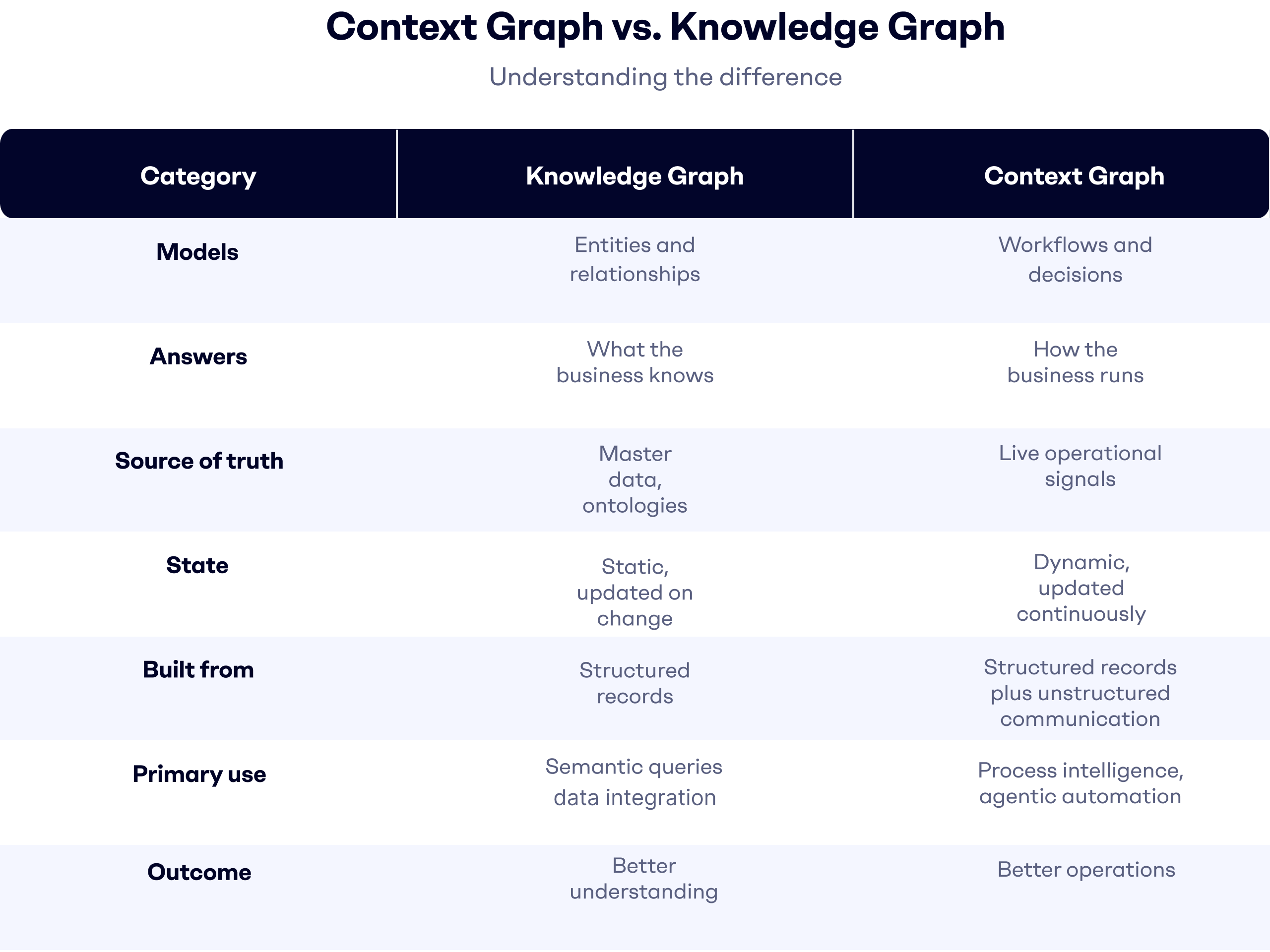
Context Graph vs Knowledge Graph: The Core Distinctions
At the surface, both are graphs. In practice, they answer different questions, optimize for different problems, and support different generations of AI applications.
A knowledge graph answers what is true right now. A context graph answers how did we get here, and what should happen next. A knowledge graph is primarily read-only semantic infrastructure. A context graph is a living operational layer that grows every time a business process executes.
The inputs differ too. Knowledge graphs are typically built from structured systems of record: CRMs, ERPs, master data. Context graphs must ingest something most enterprises have never tried to structure: unstructured communication. Emails, tickets, documents, chats, and meeting notes are where real operational context actually lives.
Without that unstructured layer, a graph is a model of the org chart. Not a model of the work.
Context Graph vs Process Map: Why the Difference Matters
The same distinction shows up when we compare a context graph against a tool every enterprise already owns: the process map. Many operations leaders have process documentation in some form. Visio diagrams, BPMN models, SOPs, playbooks. So a fair question is: how is a context graph different from a process map?
A process map is a static artifact. Someone in operations drew it, usually years ago, and filed it away. It represents how a business process should work in theory. It does not update when reality changes, and it has no mechanism for capturing the edge cases that dominate real enterprise work.
A context graph is the opposite. It is built from actual system activity, continuously updated, and structured for machine reasoning rather than human inspection. Where a process map captures the intent of a process, a context graph captures the lived behavior of that same process, including every exception, workaround, and handover that the map never documented.
For most enterprises, the gap between their process maps and their actual operations is the biggest hidden source of AI failure. The map says the invoice goes to finance. The context graph shows that in forty percent of cases, the invoice sits in a shared inbox for six days before anyone touches it. One of those views is a belief. The other is the truth.
Why This Distinction Matters for Enterprise AI
Knowledge Graphs Power Retrieval. Context Graphs Power Execution.
GraphRAG, the dominant use of knowledge graphs in AI, has a clear ceiling. It improves what an LLM knows about your enterprise. It does not improve what the LLM should do inside your processes. That gap is exactly why so many enterprise AI pilots stall at the "impressive demo" stage.
Context graphs exist because the next wave of enterprise AI is not about answering questions. It is about executing work. Agents handling a customer complaint. Agents processing an invoice exception. Agents triaging a shared inbox and creating the right case in Salesforce. Execution requires more than facts. It requires the operational memory of how similar situations were handled before. This is where context graph enterprise automation starts to deliver measurable impact.
Research on context-enriched retrieval consistently shows measurable hallucination reduction. The MEGA-RAG framework, published in 2025, delivered over 40% hallucination reduction in biomedical applications by layering multi-evidence aggregation onto standard retrieval. The principle generalizes beyond healthcare. When an agent has access to structured, validated operational context instead of just documents, it guesses less. It is no longer interpreting how your business works. It is reading it.
Context Graphs Make Agent Decisions Explainable
According to Deloitte, only 21% of organizations have mature governance for autonomous AI agents. Gartner projects that by 2028, more than 95% of enterprises will have deployed generative AI in some form. That gap is a compliance problem waiting to happen.
Context graphs close it. Because they store the decision trace, every action an agent takes can be reconstructed, audited, and challenged. Doing that across mailboxes, tickets, and CRM cases requires a tracing layer that stitches events from every system into one coherent thread. Tekst calls this layer Universal Tracing: the unique capability to capture unstructured communication and events directly into process intelligence. This matters for regulated industries, but it also matters for internal trust. An agent that cannot explain itself will never be given real authority. A context graph is what lets it explain itself.
Final Thought: A Graph of Facts Is Not a Graph of Work
A knowledge graph tells you what exists. A context graph tells you how your enterprise actually operates. Both are valuable. Only one is a foundation for autonomous execution.
If a knowledge graph is the library, a context graph is the operating manual written by the people who actually run the place. And once you've seen the difference, it becomes hard to unsee why so many enterprise AI projects never make it past retrieval.
For a deeper look at how context graphs are built from real enterprise operations, see the enterprise operations definition of a context graph, or explore how Tekst works in practice.
Discover the impact of AI on your enterprise. We're here to help you get started.