Custom Trained AI: The Intelligence Layer Enterprise Systems Are Missing
Your team has ChatGPT, Microsoft Copilot, and Salesforce Einstein. Yet someone is still copying customer data from Outlook into SAP. A claims handler is still rerouting a misclassified email. Custom trained AI explains why that gap exists, and how enterprises close it. This pillar covers what custom trained AI is, why generic models fall short, how it compares to fine-tuning, RAG, and RPA, and where it delivers measurable results inside SAP, Salesforce, and the inboxes that drive your business.
What is custom trained AI?
Custom trained AI is artificial intelligence trained on a specific organization's proprietary data, language, and edge cases, so it can classify, extract, and decide with accuracy that generic foundation models cannot match.
A generic LLM knows how the internet talks. A custom trained model knows how your customers, suppliers, and employees talk. It recognizes that a "Reklamation" from your German client is a formal complaint with a specific escalation path, not a generic question. It understands that "as discussed last week" in your sales mailbox refers to a contract addendum, not a new opportunity.
That precision is what separates an AI that demos well from an AI that runs in production. Morgan Stanley's GPT-4 deployment, fine-tuned on the firm's proprietary research, is used daily by 98 percent of its advisor teams. Comparative analyses consistently show that domain-trained models outperform general-purpose LLMs on enterprise-specific tasks.
Custom trained AI is not a product. It is an architectural choice: a non-replaceable intelligence layer, trained on your operational reality, sitting between your systems of record (SAP, Salesforce, ERP, CRM) and your systems of communication (email, shared inboxes, documents). That layer turns information into action without a person in the middle.
Why generic AI (ChatGPT, Copilot, Agentforce) falls short in the enterprise
Generic AI is built for breadth. Enterprise operations need depth. That mismatch is the entire problem.
RAND Corporation reported in late 2025 that 80.3 percent of enterprise AI projects fail to deliver business value: 33.8 percent are abandoned before production, 28.4 percent reach production but never deliver value, 18.1 percent never recoup costs. Gartner's survey of 782 I&O leaders found that only 28 percent of AI use cases meet ROI expectations, while 20 percent fail outright. Half of generative AI proofs-of-concept were abandoned in the same period.
The failures cluster around four patterns.
No operational context. Copilot can write an email. It cannot route a misclassified order from a German distributor to the right rep in Antwerp, create the matching case in Salesforce, and trigger the credit memo in SAP. Generic AI sees the message, not the workflow.
No cross-system intelligence. Salesforce Einstein and Agentforce see Salesforce. SAP Joule sees SAP. Neither sees the email thread that started the dispute or the scanned PDF that proves the quantity ordered. Real enterprise work happens across systems.
No language fluency on edge cases. Generic models are trained on the public internet. Your business is not. Your customers send messages mixing Dutch, French, English, and German. Your suppliers attach PDFs with handwritten amendments. The patterns that matter are the rare ones, not the common ones.
No continuous learning loop. Generic AI is updated on the vendor's schedule. When your operations change (new product line, new acquisition, new regulation), the model does not adapt. You file a support ticket and wait.
Gartner predicts 60 percent of AI projects will be cancelled by the end of 2026 because of inadequate data foundations. The deeper failure is structural: enterprises bought a tool and expected a transformation. Custom trained AI is the architecture, not the tool, that closes the gap.
Custom trained AI vs. fine-tuning vs. RAG vs. custom GPTs
Custom trained AI, fine-tuning, RAG, and Custom GPTs are four distinct approaches to AI customization. Each is suited to a different use case, and confusing them is one of the most common reasons enterprise AI projects fail. The choice between them often decides whether your project lands in the 20 percent that succeeds or the 80 percent that does not.
Fine-tuning
Fine-tuning takes an existing foundation model and continues its training on a curated dataset of your examples. Fast to start, useful for narrow tasks like classifying support tickets in your brand voice. It does not give the model new knowledge in real time, and it does not integrate with enterprise systems on its own.
Retrieval-Augmented Generation (RAG)
RAG keeps the foundation model unchanged. At query time, it retrieves relevant chunks from your data and passes them to the model as context. Excellent for question-answering over knowledge bases. Limited for reasoning across documents, unstructured communication, and workflows that require decisions. Retrieval alone cannot run operations.
Custom GPTs and prompt-engineered assistants
A wrapper around a generic model with a configured system prompt and optional file uploads. The lightest form of customization. Useful for internal productivity. Not suitable for production operations that require accuracy guarantees, audit trails, or SAP/Salesforce integration.
Custom trained AI models
The most architecturally distinct option. Models are trained substantially on your organization's language, edge cases, and operational data. Not interchangeable with foundation models. They handle classification, extraction, and decision-making at production accuracy across multilingual, mixed-format communication, and they learn continuously from execution.
Most mature enterprises in 2026 run a hybrid: generic LLMs for breadth, custom trained AI for the operations that move money, fulfill orders, manage claims, and serve customers. The question is not either-or. It is where to put the boundary.
How custom trained AI works under the hood
Custom trained AI is a pipeline that turns unstructured business communication into structured, executable decisions, then learns from every execution.
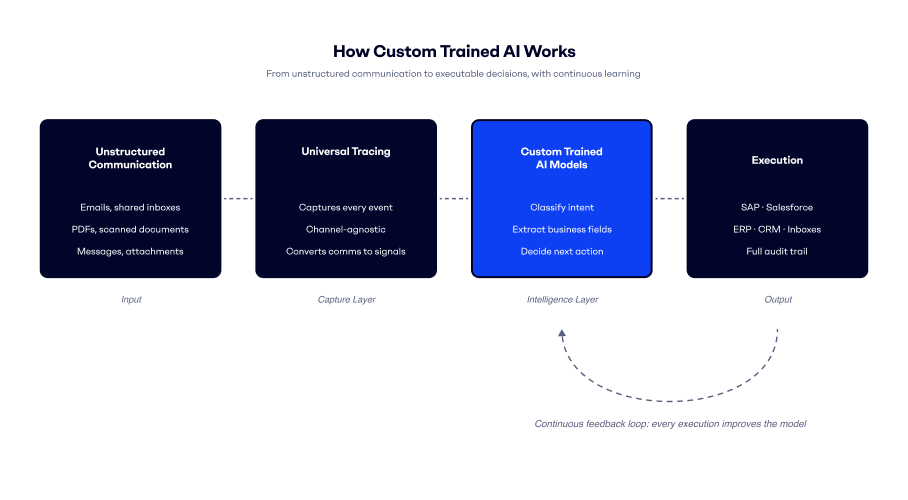
Capturing unstructured communication into the model
Operational reality lives in emails, messages, PDFs, scanned documents, and notes. A model trained only on structured ERP data is blind to where most decisions actually originate.
This is where Tekst's Universal Tracing component plays a structural role. It captures every communication event, regardless of channel or format, and converts it into a traceable event that feeds the process intelligence layer. Without that capture layer, custom trained AI is starved of the data it needs. With it, the AI sees the full operational picture, not just the database rows.
Training on your proprietary language and edge cases
Once captured, the pipeline classifies messages by intent and workflow type, extracts business-relevant fields (order number, customer ID, product code, claim type), and learns the decisions that experienced employees make in each combination of signals. The training data is your data: historical emails, case notes, ticket resolutions, document flows. The model learns what good operational decisions look like inside your specific domain.
Classification, extraction, and decision-making
In production, the model performs three tasks on every incoming communication. Classification assigns it to a workflow. Extraction pulls the structured fields. Decision-making selects the next action: route, create a case, trigger a credit memo, request more information. Tekst customers reach 95 percent classification accuracy at Tenneco across eight EMEA regions, and 90 percent routing accuracy at Securex across 2.3 million emails a year.
Continuous learning and drift correction
Every execution generates new data. Was the routing correct? Did the extracted field match? Did a person intervene? These signals flow back into the model. Drift is detected automatically and retraining happens continuously, not on a quarterly release cycle. Generic AI delivers a static product. Custom trained AI delivers a system that gets smarter daily.
Custom Trained AI vs. RPA: why agentic beats rules-based
Custom trained AI differs from RPA in three ways: it reasons over context instead of following rules, it handles unstructured edge cases instead of breaking on them, and it learns continuously instead of requiring redeployment for every change.
Robotic Process Automation was the previous answer to manual work, and it broke for predictable reasons. Ernst & Young reports 30 to 50 percent of RPA projects fail. Development teams spend 80 percent of their effort on exception handling, leaving 20 percent for the happy path. HfS Research found that maintenance consumes 70 to 75 percent of total RPA budgets.
The reason is structural. RPA is a rules engine: it reads a screen, clicks a button, copies a field. It works perfectly inside the scenario it was designed for. The moment reality changes (a layout update, a handwritten note, a new email template, a multilingual customer), the bot breaks and a person fixes it.
Custom trained AI does not follow rules. It reasons over context. A custom model can read a German quote with a handwritten amendment, classify it correctly, extract the relevant fields, and route it without a rule being written for that exact case. It handles the 80 percent of edge cases that RPA forces people to handle manually.
There is also a visibility difference. RPA can trace its own clicks. It cannot trace the communication that caused the action. Tekst's Universal Tracing layer closes that gap by capturing every upstream event, so the custom trained AI has visibility into both cause and action. RPA sees half the picture. Agentic process automation sees the whole one.
This is why enterprises that replaced RPA with agentic execution see results RPA could not produce. Becton Dickinson reached results in three weeks, manages more than 100,000 topics across multiple languages, and improved service delivery without adding headcount. Milcobel processes 250,000 emails a year with 200 percent faster first-response time. Tenneco unified eight fragmented EMEA operations into a single live workflow.
Where custom trained AI delivers in enterprise operations
Custom trained AI delivers measurable value in four enterprise operations: order processing, customer service, claims and invoice handling, and cross-system orchestration. These are the workflows where unstructured communication meets systems of record, which is where generic AI breaks.
Order processing and fulfillment
Sales orders arrive by email, PDF, EDI, supplier portal, and increasingly messaging apps. A custom trained model reads the order in any format, extracts the line items, validates them against the ERP catalog, creates the sales order in SAP, and replies to the customer. The model also learns the patterns: "URGENT" from a contract customer triggers a 24-hour SLA, "for next month" means the first business day, because that is what the historical data says.
Customer service and shared inboxes
Shared mailboxes are the chokepoint of enterprise operations. They receive complaints, status requests, claims, and technical questions. A custom trained model classifies each message, extracts the relevant fields, opens the right case in Salesforce or ServiceNow, drafts informational responses, and escalates only what needs human judgment. Securex manages 2.3 million emails a year this way, with routing accuracy improving from 50 percent to 90 percent in weeks.
Claims, invoices, and back-office workflows
Insurance claims, supplier invoices, and HR requests share the same profile: high volume, unstructured input, regulatory exposure, expensive errors. Custom trained AI extracts the structured fields, validates them against business rules, routes exceptions, and creates the records in the ERP or claims system. The audit trail is preserved at every step.
Cross-system orchestration (SAP, Salesforce, ERP, CRM)
The hardest enterprise work crosses systems: a customer complaint that needs a credit note in SAP, a case update in Salesforce, a logistics notification, and a customer follow-up. Generic AI cannot orchestrate this. RPA breaks at the first layout change. Custom trained AI, sitting on a process intelligence layer, executes the full sequence and learns where it gets stuck.
How to build the business case for custom trained AI
The business case has three components finance leaders can stress-test.
Cost displaced. Calculate the loaded cost of the manual work the AI replaces (time per case, volume per year, hourly rate). Tekst customers typically automate 70 to 90 percent of routine cases.
Speed of value. The AI projects that fail take too long. Six-month discovery workshops drain budgets before any value lands. Becton Dickinson reached production in three weeks. Tenneco was live across EMEA while traditional vendors were still in workshops. Time-to-value belongs in the model as a hard metric, not an afterthought.
Quality and risk reduction. Manual processing produces errors at a rate few enterprises measure precisely, but every operations leader feels: routing mistakes, missed SLAs, escalations that should have been automated. Custom trained AI delivers a measurable accuracy floor (95 percent classification, 90 percent routing) that manual operations rarely match consistently.
The pattern that breaks the business case is over-scope. Trying to automate everything at once produces nothing. The pattern that works is selecting one high-volume, high-pain workflow, deploying custom trained AI on it, measuring the result, and using the win to fund the next.
Build vs. buy vs. platform: choosing the right approach
Enterprises deploying custom trained AI face three routes.
Build in-house. A team of ML engineers, data scientists, and ML ops specialists trains and maintains the models. This is the path Bloomberg took with BloombergGPT, at a reported cost of several million dollars and a multi-year program. It works for organizations with the talent, the patience, and a strategic reason to make AI a core in-house capability. Most enterprises meet none of those three conditions.
Buy point solutions. Vertical AI vendors offer custom models for specific use cases (claims, contracts, invoices). They work when the use case fits the vendor's scope exactly. They struggle when workflows cross systems, when languages diversify, or when the business changes. Integration and maintenance become recurring projects.
Adopt a platform. A platform approach combines custom trained AI models, a process intelligence layer, an automation engine, and a continuous learning loop, sold as a managed service. The enterprise contributes data and domain knowledge. The platform delivers the trained models, the integrations, and the orchestration. Deployment drops from quarters to weeks. This is the architecture Tekst.com delivers as Agentic Process Automation.
For most operations leaders the decision turns on three questions: do you have in-house ML talent for a five-year program, do your workflows fit a single vertical vendor's scope, and can you afford six months before the first production result? When the answers are no, no, and no, the platform route is the realistic path.
Implementation roadmap: start small, scale fast
Successful custom trained AI projects follow a consistent four-phase pattern.
Phase 1: Select one workflow. High volume, measurable pain, clear ownership. Customer service inboxes, order intake, and claims routing are the typical starting points. Avoid horizontal "AI strategy" projects.
Phase 2: Train and deploy. Capture the historical data. Train the models on your proprietary language and edge cases. Deploy with human oversight on every decision. Tekst customers typically reach production accuracy in three to six weeks.
Phase 3: Measure and harden. Track classification accuracy, extraction accuracy, intervention rate, and time-to-resolution. Hand off more decisions to autonomous execution as confidence grows. This is where the continuous learning loop earns its keep.
Phase 4: Replicate. Once one workflow is stable, the data foundations and integrations make the second workflow significantly faster. Compound the automation footprint without compounding change management.
The anti-pattern is skipping Phase 1 in favor of an enterprise-wide AI strategy. That is what produces the 80 percent failure rate. Custom trained AI rewards focus.
Risks, governance, and data sovereignty
The risks are manageable when addressed in the architecture, not bolted on later.
Data privacy and residency. Custom trained AI runs on your data, which for European enterprises is subject to GDPR, sector regulation, and the EU AI Act. The platform must support processing within the relevant jurisdiction, with documentation of where data is stored and how it is used in training. SOC 2 compliance is the baseline. Full audit trails are non-negotiable for regulated industries.
Explainability. Operations leaders are accountable for the decisions their systems make. Black-box AI is not acceptable when a misrouted claim costs real money. Every classification, extraction, and decision should be transparent and auditable.
Model drift and oversight. Models that learn continuously can also drift. Governance requires monitoring accuracy over time, alerting when intervention rates rise, and clear human-in-the-loop checkpoints for high-stakes decisions.
Vendor lock-in. Custom trained AI is trained on your data. Contracts should specify data portability, model ownership, and exit provisions. The deeper the integration, the more important the exit clause.
Done well, custom trained AI is not just safer than generic AI. It is the only architecture that can meet enterprise compliance while delivering operational value at scale.
The intelligence layer enterprise systems are missing
Generic AI gave enterprises a glimpse of what is possible. Custom trained AI is how operations leaders make it real. Enterprises that treat AI as a productivity feature get a productivity feature. Enterprises that treat AI as an intelligence layer, trained on their language, connected to their systems, learning from their workflows, get operations that run themselves.
The market is shifting at speed. The agentic AI market is projected to grow from $6.96 billion in 2025 to more than $57 billion by 2031, a 42 percent CAGR that exceeds every prior wave of enterprise automation. The question is no longer whether custom trained AI matters. It is how fast you can stop burning your best talent on robotic work, and which workflow goes first.
.png)
Discover the impact of AI on your enterprise. We're here to help you get started.