What are AI-powered workflows? A practical guide for enterprise operations
Talk to any operations leader running a 5,000-person organisation today and you'll hear the same story. They've bought workflow tools. They've rolled out RPA bots. They've piloted GPT in three departments. And somehow, the team is still spending its mornings in Outlook, copying order numbers into SAP, chasing the right approver, and stitching context across five systems.
That's the problem AI-powered workflows are built to solve. Not by adding another chatbot or another integration. By moving the intelligence layer out of people's heads and into the flow of work itself.
Here's what they actually are, how they differ from what came before, and how to tell which ones will survive the next 24 months instead of joining the 40 percent of agentic AI projects Gartner expects to be cancelled by 2027.
What is an AI-powered workflow?
An AI-powered workflow is a business process where AI interprets inputs, makes decisions, and executes actions across enterprise systems, with humans supervising boundaries rather than performing each step.
Three pieces matter. First, AI does the reading and reasoning, including on the messy stuff: emails with vague subject lines, attachments, partially filled forms, multilingual replies. Second, the workflow acts, meaning it updates SAP, opens a Salesforce case, sends a confirmation, or escalates to the right person. Third, the loop closes, so every interaction makes the next one slightly smarter.
A workflow that only reads is an analytics tool. A workflow that only executes is RPA. AI-powered workflows do both, and that's the entire point.
AI-powered workflows vs. traditional automation
Traditional RPA assumes a predictable world. It performs well until something changes: a new invoice layout, a handwritten note on a delivery slip, a customer who replies in German when the bot expects French. Industry estimates place RPA failure rates between 30 and 50 percent, and HfS Research has reported that maintenance can consume 70 to 75 percent of total RPA budgets once the bots are live.
That last row is the one operations leaders feel hardest. RPA optimises a step. AI-powered workflows optimise an outcome.
How an AI-powered workflow actually runs
Picture an inbound email about a delayed shipment. An AI-powered workflow reads the message, recognises the intent as a delivery exception, extracts the order ID, looks it up in SAP, checks carrier status, and decides what to do next. If the answer is clear, it drafts and sends a reply, updates the CRM case, and flags the carrier issue in the supply chain dashboard. If something looks unusual, it routes to a human with the full context already attached.
All of that happens in seconds, without anyone manually combining information across systems. The human stays in control of what the AI is allowed to do, what falls outside its boundaries, and what improves over time.
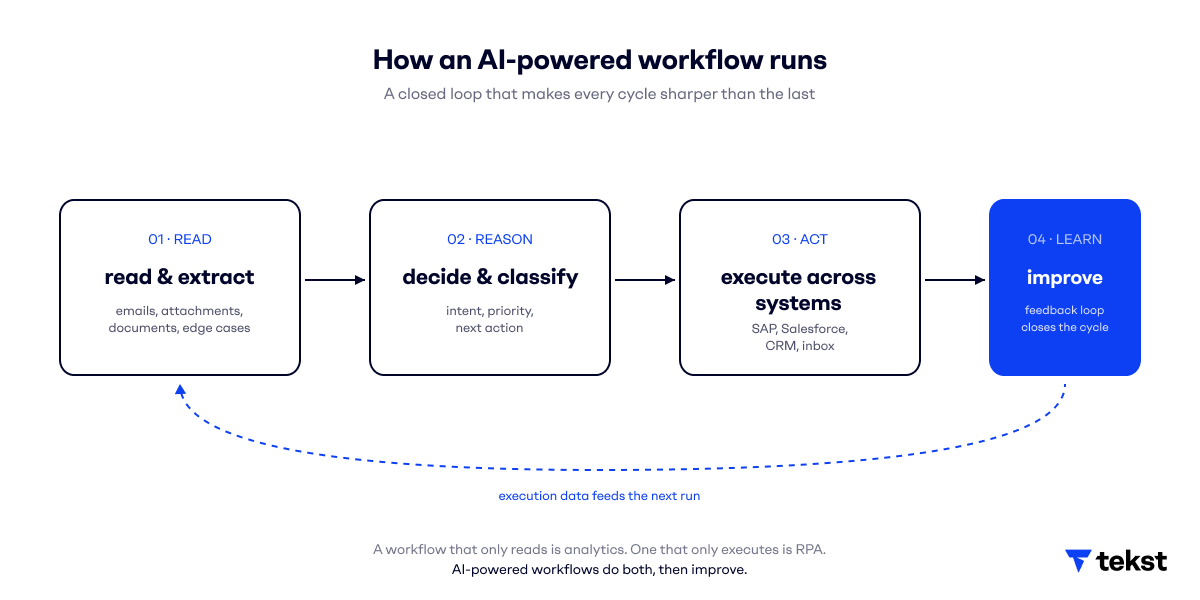
This is the closed loop Tekst refers to when we talk about Process Intelligence as the foundation for automation: mining how work actually flows, executing across systems, then feeding execution data back into the model so the next run is sharper than the last.
Enterprise use cases that pay back fastest
The fastest payback comes from the inboxes where the most downstream work originates. As Tekst's inbox-to-process webinar highlights, a large share of enterprise processes still start in an inbox, with McKinsey research showing knowledge workers spend roughly 28 percent of their workweek on email alone. That's where AI-powered workflows quietly take over the busywork.
Common, high-impact examples:
- Order intake and quote handling in manufacturing and distribution, where AI reads the request, matches it to the right product code, and creates the order in ERP.
- Accounts payable, where invoices arrive as PDFs, photos, and email attachments, and the workflow extracts, validates, and routes them for approval.
- Customer service and shared inbox triage, where every incoming case is classified, enriched with history, and routed in seconds.
- HR and payroll operations, where employee requests get logged, prioritised, and answered without a ticket sitting unread for two days.
The proof points are concrete. Becton Dickinson handles 1.4 million annual inquiries in over 15 languages and went live in three weeks with 87 percent faster response times. Tenneco unified eight fragmented EMEA regions into one operation at 95 percent classification accuracy. Milcobel cut first-response time by 200 percent across 250,000 emails per year.
Why most AI-powered workflows still fail at scale
Gartner expects more than 40 percent of agentic AI projects to be cancelled by the end of 2027, driven by escalating costs, unclear business value, and inadequate risk controls. The ones that survive share a common architecture: they treat AI as an execution layer, not a feature. That's the foundation of agentic process automation.
The cancellations rarely happen because the AI was bad. They happen because the workflow couldn't be trusted, couldn't be audited, or couldn't handle the long tail of edge cases the demo never showed.
Three failure modes show up again and again. Generic foundation models don't speak the customer's vocabulary, so accuracy collapses on day two. There's no way to see what the AI actually did on a given case, so compliance and operations lose confidence. And there's no feedback loop, so the same exceptions keep arriving.
Enterprise-grade AI-powered workflows solve for all three.
What separates an enterprise-grade AI-powered workflow
Three things separate the workflows that scale from the ones that get quietly retired.
Custom-trained models. Foundation models are a starting point, not an answer. The workflow needs models tuned to the organisation's terminology, products, customer base, and edge cases. A quote arriving in German with a handwritten note isn't an exception, it's a Tuesday.
Built-in observability. Every decision the AI makes needs to be traceable: what input it received, which classification it produced, which action it triggered, and which downstream system it touched. Tekst calls this Universal Tracing, and it's what turns AI from a black box into something operations and compliance teams can defend in an audit.
Continuous improvement. Execution data has to feed back into the model. The same workflow should be measurably better after 90 days than it was on day one, not because someone retrained it manually, but because the loop is built that way.
Build, monitor, improve: the three interfaces operations teams need
In Tekst, this translates into three interfaces that sit on top of every automation. Builder is the configuration environment where teams design and deploy agentic workflows based on structured process data. Monitor is the control interface that tracks execution, accuracy, intervention rates, and system performance in real time. Insights is the reporting layer that aggregates automation metrics, business impact data, and the signals that tell you where to automate next.
You build once, watch it run, and let the system show you what to optimise. That's the difference between launching one automation and running an automation programme.
Getting started with AI-powered workflows
You don't need a 12-month transformation plan. You need to pick the inbox where the most downstream work originates, instrument it, and put a single workflow into production. Most enterprises see the first measurable results within weeks: shorter response times, fewer escalations, and a much clearer picture of where the next workflow should live.
The shift isn't technical, it's strategic. RPA automated the obvious. AI-powered workflows automate the overlooked, and they keep getting better while they do it. That's what makes AI-powered workflows the operational expression of agentic process automation: a closed loop where intelligence and execution compound over time.
Discover the impact of AI on your enterprise. We're here to help you get started.