What Is RFQ Automation, and Why Your CPQ Can't Do It Alone
A procurement manager emails a supplier a spreadsheet of part numbers and asks for pricing by Friday. A distributor's shared inbox receives a scanned PDF with product codes written in the buyer's internal shorthand. A regional account manager forwards a one-line message asking for "the usual order, but bigger this time, see attached." Each of these is a request for quote, and each one lands somewhere a CPQ tool cannot read it. Someone has to open it, interpret it, and retype it before configuration and pricing can even start. RFQ automation, the discipline Tekst applies to exactly this gap, is the step most quote-to-cash strategies quietly skip.
What Is an RFQ, and Why Does It Create a Data Entry Problem?
A request for quote (RFQ) is a formal or informal inquiry from a buyer to a supplier, requesting pricing and availability information for specific products or services. In B2B commerce, RFQs commonly arrive as unstructured emails or PDF documents, often formatted to the buyer's internal standards rather than the supplier's system requirements. This format mismatch is the source of significant manual work in the quote-to-cash process.
A CPQ tool can configure and price a request in minutes once the data is inside it. Getting the data inside it is the part nobody automated: someone on the sales or sales operations team reads the RFQ, matches product codes to the internal catalog, checks quantities and delivery dates, and types it all into the CPQ by hand. At low volumes this is a nuisance. At the volumes enterprise manufacturers and distributors handle, it is a standing bottleneck between the customer's inbox and the first price the customer sees, and precisely the friction Tekst is built to remove.
What Is RFQ Automation?
RFQ automation is the use of AI to read incoming quote requests, regardless of format, extract structured product, quantity, and delivery requirements, and route them to the correct internal system or team for quoting. In quote-to-cash workflows, RFQ automation typically connects to a CPQ tool: it transforms the unstructured customer inquiry into the structured input the CPQ needs to configure and price a response.
This is exactly the layer Tekst operates in. Tekst reads the RFQ the way a person would, works out what is actually being requested, and hands the CPQ or the sales team a structured record instead of a wall of unstructured text.
How RFQ Automation Works, and Where Tekst Fits
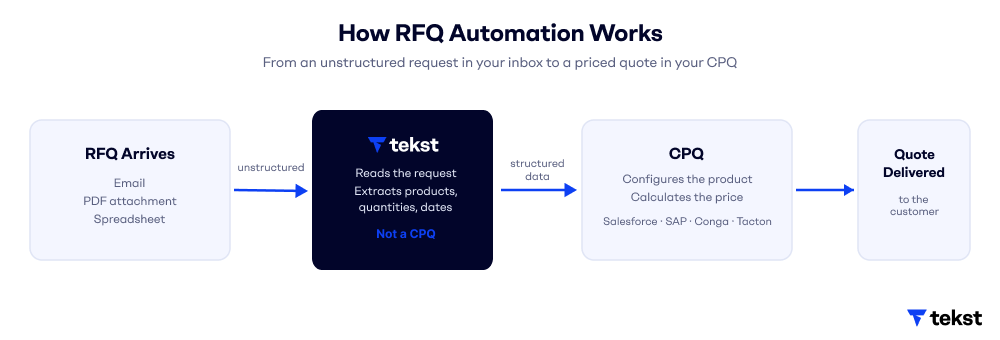
The flow is straightforward once the reading problem is solved. An RFQ arrives by email, with or without an attachment. Tekst reads the message and any attached document and extracts the requirements: product codes, quantities, delivery dates, and any special conditions the buyer mentioned. That structured data is then routed to the sales team or fed directly into the CPQ, so a rep can review, configure, and price without re-keying anything.
Inside the quote phase, Tekst's role maps to a specific set of tasks: setting up or updating a customer record in the CRM when a new prospect sends an RFQ, extracting the requirements from the request itself (the needs-discovery step that used to mean a person reading the email line by line), delivering the finished quote back to the customer, and processing the acceptance once the customer responds.
What Tekst does not do is configure the product or calculate the price. That is the CPQ's job, and Tekst hands it over rather than trying to replace it. Tekst also does not generate the quote document itself. To be direct about it: Tekst is not a CPQ. It is the layer that makes sure the CPQ gets clean, structured input instead of an email thread.
The Difference Between RFQ Automation and CPQ Automation
These two terms get used almost interchangeably, and that causes confusion. CPQ automation is about what happens once a request is already structured: configuring the product, applying pricing and discount rules, and generating a proposal. CPQ tools such as Salesforce CPQ, SAP CPQ, Conga, and Tacton are built for exactly that job, and they do it well once the data is already in the system. RFQ automation is about what happens before that. None of those CPQ platforms are built to read an unstructured email or a PDF attached to it, which means the intake problem stays unsolved no matter which CPQ a company runs. That is the gap Tekst is built to close.
RFQ automation and CPQ automation are complementary, not competing. A CPQ tool does its best work on clean data. Tekst is what makes that CPQ work in the real world, where customers do not use your portal and do not format their requests the way your system expects. For a company evaluating how to fix a slow quote cycle, the CPQ is rarely the bottleneck. The unread inbox in front of it is, and that is the problem Tekst solves.
Where RFQ Automation Fits in the Quote-to-Cash Process
RFQ automation sits at the very start of quote-to-cash (Q2C), often used interchangeably with order-to-cash (O2C): the end-to-end process from a customer's first quote request to the resolution of the final dispute. Quote is phase one of seven, and it sets the tone for everything downstream. A clean, structured quote request means faster pricing, a more accurate proposal, and, further down the line, an order that actually matches what was quoted.
This is also where Tekst's broader role in Q2C becomes visible. The same conversation mining that reads an RFQ email is what reads a purchase order in the order phase or a short-payment notice in the dispute phase. Tekst maps unstructured communication, wherever it enters the process, onto the systems that already run the business: CPQ, ERP, CRM. For the full picture of how quote-to-cash works phase by phase, see Tekst's guide to the quote-to-cash process, and for a phase-by-phase breakdown of where automation genuinely applies across quote, order, and dispute, see what quote-to-cash automation actually covers.
What to Expect from RFQ Automation in Practice
There is no way around it: the quote phase has less public proof behind it today than the order phase. What is well established is the underlying pattern, because Tekst has already deployed it at scale on the order side. At Dossche Mills, Tekst automated order routing and entry into SAP across an entire EMEA customer service operation, reaching over 95% classification accuracy and €100k in net annual savings. At Mitsubishi Chemical Group, where 60% of orders required manual entry that consumed a fifth of inside sales time, Tekst replaced a legacy OCR tool that only handled 4% of orders with AI-driven order entry into the ERP.
The RFQ case is the same problem one step earlier: unstructured communication in, structured data out, no manual re-entry in between. The volumes differ and the destination system is a CPQ instead of an ERP, but the mechanism Tekst runs on is identical. For sales operations teams, the practical case for RFQ automation is time: every RFQ a rep spends re-keying into a CPQ is time not spent selling, negotiating, or chasing the deal. Automating the intake step does not touch the CPQ's job. It removes the step that happens before the CPQ opens.
RFQ automation will not replace your CPQ, and it should not try to. What it does is close the gap between the moment a customer's request lands in your inbox and the moment your CPQ can actually use it, often the single largest source of delay in the quote cycle, and the easiest one to fix without touching the systems already in place. Read more about how Tekst applies the same intelligence layer across the order phase, or see the full quote-to-cash vs order-to-cash breakdown.

Discover the impact of AI on your enterprise. We're here to help you get started.