What Is the Quote-to-Cash Process? A Guide for Enterprise Operations

A quote request lands in a shared inbox and waits for someone to read it. A purchase order arrives as a PDF and someone retypes it into SAP. A deduction notice shows up weeks after the invoice, and three people spend an afternoon figuring out what it refers to. Every one of those moments is part of the same quote-to-cash process. Most companies just never look at it as one.
What is the quote-to-cash process?
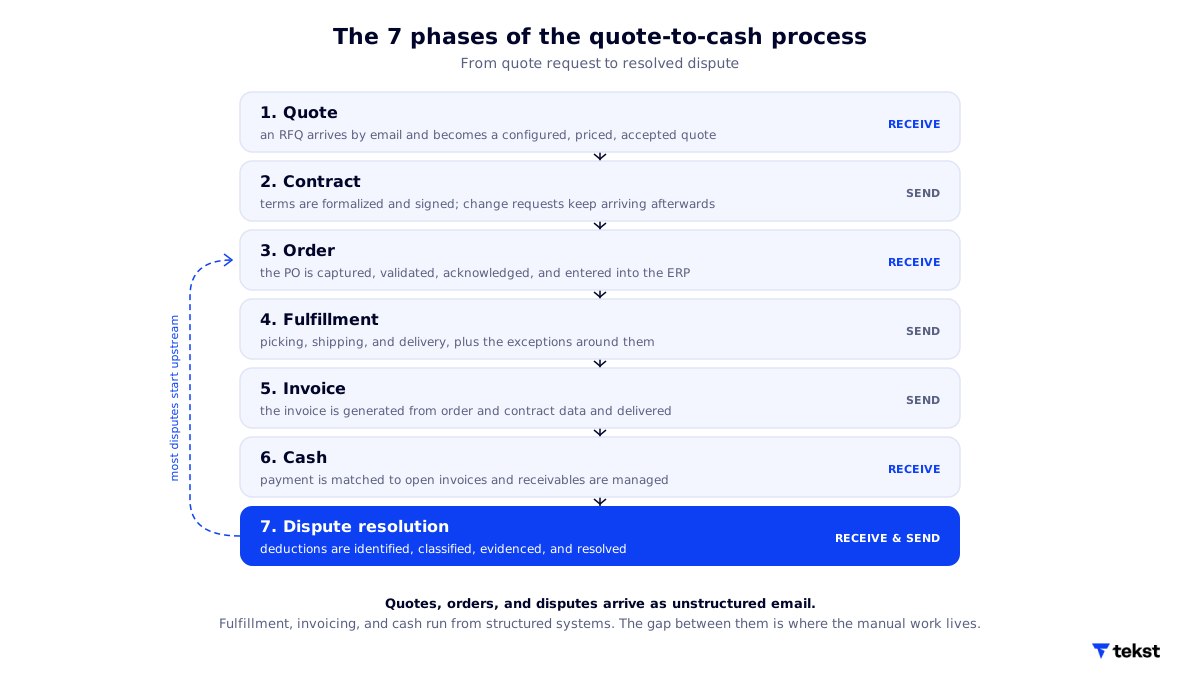
The quote-to-cash (Q2C) process, often used interchangeably with order-to-cash (O2C), is the end-to-end business process that runs from a customer's first quote request to the resolution of the final dispute. It connects sales, operations, and finance, and it spans seven phases: quote, contract, order, fulfillment, invoice, cash, and dispute resolution.
Quote-to-cash matters because it is the process that turns customer demand into revenue. Every delay, error, or manual handoff inside it shows up directly in response times, error rates, and working capital.
The 7 phases of the quote-to-cash process
Each phase has its own systems, its own teams, and its own failure modes. Here is what each one covers.
- Quote
A request for quote (RFQ) arrives, usually by email. The sales team gathers requirements, configures the product or service, calculates pricing, and delivers a quote the customer can accept. Configure, price and quote (CPQ) software owns the configuration and pricing logic. The intake and delivery around it, reading the RFQ, capturing requirements, sending the quote, getting acceptance, still runs largely on email.
- Contract
Quote accepted, terms formalized. Contract drafting, legal review, and signature typically live in contract lifecycle management (CLM) tools. After signing, the contract keeps generating work: customers email change requests that have to be interpreted, approved, and reflected in the systems downstream.
- Order
The purchase order (PO) arrives by email, PDF, or EDI. The order is captured, validated against customer master data, acknowledged, and entered into the ERP. In most B2B enterprises this is the highest-volume phase, and the most manual one: industry benchmarks put the cost of processing a single B2B order by hand between $25 and $100, and customer service teams spend 20 to 40 percent of their time on it. Then come the changes. Customers adjust quantities, dates, and delivery addresses on in-flight orders, almost always by email.
- Fulfillment
The ERP, warehouse management system, and carriers take over: picking, shipping, delivery. Around the physical flow runs a communication flow of shipment questions, delivery exceptions, and carrier updates that someone has to read and act on.
- Invoice
Billing systems generate the invoice from the order and contract data and deliver it to the customer, increasingly in structured e-invoicing formats. Accuracy here decides much of what happens in the next two phases: a wrong invoice becomes a late payment or a dispute.
- Cash
Payment arrives at the bank. Finance matches it to open invoices (cash application), manages accounts receivable, and follows up on late payments. This phase lives entirely in banking and AR systems and is measured in days sales outstanding (DSO).
- Dispute resolution
Customers short-pay, claim deductions, or dispute invoices. Each case has to be identified, classified, assigned an owner, and backed with evidence before a resolution can be approved. The stakes are real: industry research puts deductions at 5 to 15 percent of invoice value in some sectors, and disputed invoices extend DSO by 15 to 30 days. What gets resolved here also feeds back upstream, because most disputes start as an error in an earlier phase.
Quote-to-cash vs order-to-cash: what's the difference?
The difference between quote-to-cash and order-to-cash is the starting point. Quote-to-cash starts at the quote request and includes the CPQ and contracting phases; it is the term used in the salestech world. Order-to-cash starts at order receipt and is the native term in the ERP and finance world. In practice the two terms describe the same end-to-end revenue process, which is why they are often used interchangeably.
Quote-to-cash vs CPQ
CPQ is a component of quote-to-cash, not a synonym for it. CPQ software handles the configure, price and quote logic at the start of the cycle. Quote-to-cash is the full process that CPQ feeds into: contracts, orders, fulfillment, invoicing, cash, and disputes.
Many systems, one process: the quote-to-cash landscape
Every phase of quote-to-cash already has dedicated software. CRM and CPQ own the quote. CLM owns the contract. The ERP owns orders and fulfillment. Billing platforms own the invoice. Banking and AR systems own cash. None of these systems is the problem, and none of them needs replacing.
The problem is what sits between them. A quote request, an order change, a deduction notice: the inputs that drive the process arrive as unstructured communication that no ERP, CPQ, or billing system can read. So people read it. They interpret the email, look up the account, retype the data, and ping the next team. Smart, expensive people working as the integration layer between systems, the Human API. The process is only as fast as their inbox.
This is why quote-to-cash improvement rarely means buying another system of record. It means adding an intelligence layer, the role platforms like Tekst play, that reads the unstructured communication between the phases and executes the outcome into the systems you already run.
Automating the quote-to-cash process
Quote-to-cash automation applies AI to the communication-heavy phases of the cycle: reading inbound messages and documents, classifying intent, extracting the business data, and executing the result into the ERP or CRM.
The order phase is where automation is most proven, because it combines the highest volumes with the most manual work. This is the domain of sales order automation: the AI reads the inbound order in any format, validates it, and posts it into the ERP. Dossche Mills automated order routing and entry into SAP with Tekst across its EMEA customer service operation, reaching over 95% classification accuracy and €100k in net annual savings. Mitsubishi Chemical Group, where 60% of orders required manual entry that consumed 20% of inside sales time, replaced template-based OCR that covered only 4% of orders with AI-driven order entry into the ERP. Asteria automated order intake across more than 33 subsidiaries in 10 countries, each with different processes and languages. Milcobel eliminated manual email sorting entirely, with every order, invoice query, and complaint routed automatically to the right person.
The same approach extends to the quote phase, where RFQ emails are read and turned into structured input for the CPQ, and to dispute resolution, where deductions are identified, classified, assigned, and backed with gathered evidence before a person approves the outcome. In every case the pattern is identical: the AI handles the reading, structuring, and routing; the existing systems keep doing what they do; people keep the judgment calls.
Where quote-to-cash is heading
The direction of travel is agentic AI: software that does not just flag work but completes it. Gartner predicts that 40 percent of enterprise applications will feature task-specific AI agents by the end of 2026, up from less than 5 percent in 2025. In quote-to-cash terms, that means inbound quote requests, orders, changes, and disputes increasingly get read, structured, and executed by AI, with people supervising outcomes instead of copying data.
The companies that get there first will not be the ones that replaced their systems. They will be the ones that connected them: one intelligence layer across the many systems they already run, covering the entire path from quote to resolved dispute.

Discover the impact of AI on your enterprise. We're here to help you get started.