What Is Sales Order Automation, and How Does It Actually Work?

One customer sends a structured EDI file. The next sends a PDF in German with a handwritten note in the margin. A third pastes the order lines straight into the body of an email. Every one of them has to be read, interpreted, and keyed into the ERP by a person before anything can ship. At 500 orders a week, that is not a task. It is a full-time job, and usually several. Sales order automation replaces that person-as-interface with AI that reads any format, extracts the order, validates it, posts it into the ERP, and coordinates everything that has to happen next. It is the highest-volume stage of the quote-to-cash (Q2C) process, often used interchangeably with order-to-cash (O2C).
What is sales order automation?
Sales order automation is the process of using AI to capture incoming purchase orders, regardless of format (email, EDI, PDF, fax, or portal), extract the structured order data, validate it against business rules and master data, and enter it directly into an ERP system without manual intervention.
It is the order-phase workhorse of the wider revenue cycle. Quote-to-cash (Q2C), often used interchangeably with order-to-cash (O2C), is the end-to-end process from receiving a customer quote request (or order) to resolving the final dispute. Sales order automation lives in the order phase of that process, where volumes are highest and the manual work is heaviest.
Sales order automation is often confused with order entry automation, but they are not the same thing. Order entry automation is the narrower step: the automated transfer of incoming purchase order data from any source format into an ERP or order management system, without manual data entry. It is the data pipeline that gets the order in. Sales order automation is the broader process that contains it, coordinating the validation, customer master data checks, acknowledgments, and the handoffs into fulfillment, invoicing, and reporting that follow. Put simply, order entry automation captures the data; sales order automation runs the order end to end.
The hidden cost of manual order entry
Most B2B orders still arrive the way they always have: by email, often as an attachment, written to the customer's standards rather than yours. Much of that volume is still processed manually, and email remains one of the most-used B2B ordering channels. Someone has to open each one, work out what it means, and retype it into the ERP.
That work is expensive and slow. Industry benchmarks put the cost of processing a single B2B order by hand between $25 and $100, and customer service and inside sales teams spend 20 to 40 percent of their time on it. The pattern repeats inside individual operations. At Mitsubishi Chemical Group, 60 percent of orders required manual entry that consumed 20 percent of inside sales time before automation.
This is the Human API in its purest form: skilled people acting as the integration layer between the customer's inbox and the ERP. The order is sitting in an email within seconds. The queue in front of it can run for hours.
Why ERP systems can't automate order entry on their own
ERP systems are built to record confirmed transactions in a structured format. They were never built to read an unstructured email. That gap, between the message a customer sends and the structured input the ERP expects, is exactly where the manual work lives. The systems on either side cannot close it, so people do.
Three earlier approaches tried and fell short:
- RPA automates fixed, repeatable steps. It works until a customer changes an email template or sends a non-standard layout, and then it breaks. Teams end up babysitting the automation instead of processing orders.
- OCR tools extract text from a document, but they cannot interpret intent or validate the result against your master data. They also struggle with variety: Mitsubishi's legacy template-based OCR covered only 4 percent of its orders, because every customer needed its own template.
- Manual entry is flexible but unscalable and error-prone. Manual order entry error rates commonly sit in the low single digits, around 3 to 5 percent, and every error becomes a downstream fulfillment failure, credit note, or dispute.
The missing piece in all three is the ability to read unstructured order data, understand it, and act on it. That is an intelligence problem, not a data-transfer problem.
How sales order automation works, step by step
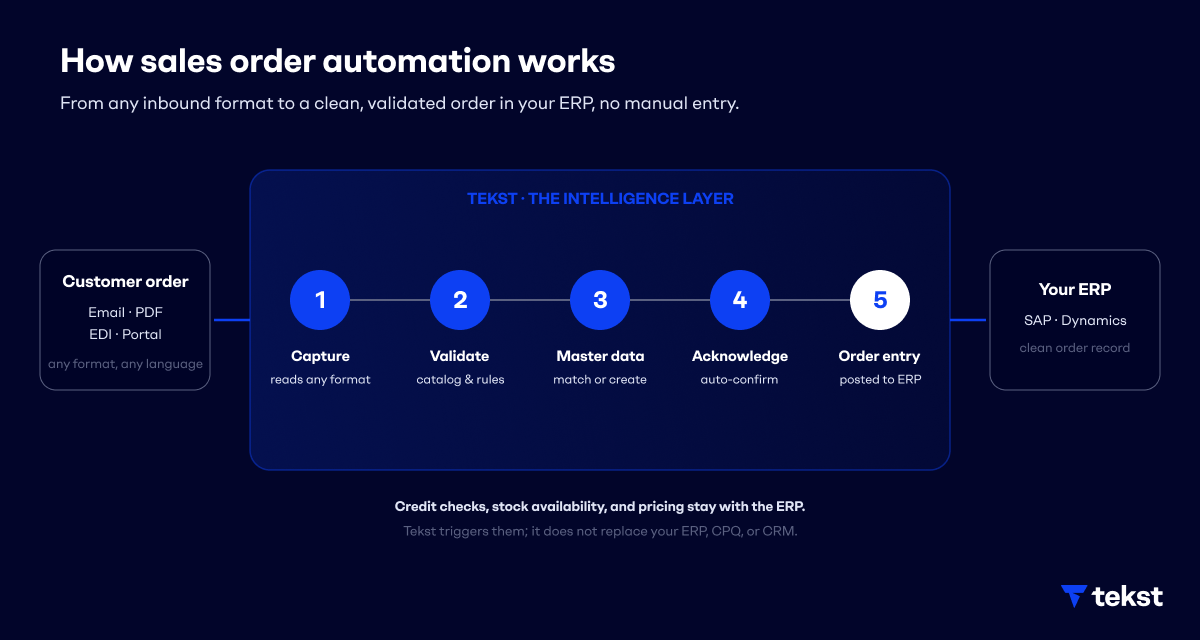
Sales order automation closes the gap by adding an intelligence layer between the inbox and the ERP. The flow is simple to describe: email in, structured order out, posted to the system. Underneath, it runs through a sequence of steps.
- Order capture. The AI reads the incoming order from any channel and any format, including emails, PDF attachments, EDI files, and portal submissions, in any language.
- Order validation. It checks the extracted order against your product catalog, quantities, and business rules, flagging anything that does not fit before it reaches the ERP.
- Customer master data check. It matches the order to the right customer record, and handles new customers or data mismatches rather than failing on them.
- Order acknowledgment. It sends an automated confirmation back to the customer, closing the loop without a human writing the reply.
- Order entry into the ERP. It posts the structured, validated order directly into SAP, Microsoft Dynamics, or your order management system as a clean record.
A platform like Tekst is the intelligence layer in that flow. It does not replace your ERP, CPQ, or CRM. It reads the communication those systems cannot, and writes the outcome into them. Where an order needs a credit check, an available-to-promise stock check, or a pricing recalculation, those remain ERP functions. The automation triggers them; it does not perform them. Anything outside the rules is surfaced to a person with the order, the validation result, and the issue already assembled, so judgment takes seconds instead of an afternoon of digging.
Where sales order automation fits in the quote-to-cash process
Order entry is phase three of the seven-phase quote-to-cash process, and it is the central one. A clean, structured order in the ERP is the prerequisite for everything downstream: faster fulfillment, accurate invoices, and fewer disputes. An error introduced at order entry compounds through the rest of the cycle, turning into a wrong shipment, a wrong invoice, and eventually a deduction someone has to investigate. This is why order entry is the most common starting point for automating quote-to-cash: it carries the highest volume, the clearest return, and it improves every phase that follows.
What results look like in enterprise operations
The order phase is where automation is most proven, because it combines the highest volumes with the most manual work. Dossche Mills automated order routing and entry into SAP with Tekst across its EMEA customer service operation, reaching over 95 percent classification accuracy and €100k in net annual savings. Mitsubishi Chemical Group, where 60 percent of orders required manual entry consuming 20 percent of inside sales time, replaced template-based OCR that covered only 4 percent of orders with AI-driven order entry into the ERP. Asteria automated order intake across more than 33 subsidiaries in 10 countries, each with different processes and languages. Milcobel eliminated manual email sorting entirely, routing every order, invoice query, and complaint to the right person automatically.
The gains are not only speed. Validating at intake removes the entry errors that cause fulfillment failures and credit notes, and it frees the people who used to rekey orders to handle exceptions and customers instead. Fewer errors at the start mean fewer disputes at the end, which is where the compounding value sits.
What to look for in a sales order automation solution
Not every tool labeled order automation does the same job. Four questions separate the ones that hold up in production from the ones that break on the first non-standard order.
- Can it handle genuinely unstructured input? Not just clean EDI and templated PDFs, but free-text emails, mixed languages, and customer-specific formats.
- Does it validate, or only extract? Pulling text off a document is not enough. The order has to be checked against your master data before it enters the ERP.
- Does it connect to your existing systems? It should write into SAP, Dynamics, or your ERP without a rip-and-replace project.
- Is the AI trained on your business? Generic models do not know your product catalog, your customers, or your edge cases. Custom-trained AI does, which is what keeps accuracy high as variety grows.
Order entry is the beachhead, not the finish line. Once orders flow in cleanly, the next pressure point is what happens when customers change them, which is the domain of order change management, and the broader case for automating the full revenue cycle, covered in quote-to-cash automation. Start with the highest-volume, most manual phase, prove it, and the rest of the process opens up from there.


Discover the impact of AI on your enterprise. We're here to help you get started.