Data Mining vs Process Mining: What's the Difference?

Data mining and process mining both look for patterns in data, but they ask different questions. Data mining searches large datasets for relationships between variables: which customers are likely to churn, which transactions look like fraud, which products sell together. Process mining reads event logs to reconstruct how a process runs, step by step: which path an order took, where it waited, and where it broke the rules. Data mining looks across records. Process mining follows a single case through time.
The two are related. The IEEE Task Force on Process Mining describes the field in its 2011 manifesto as sitting between data mining and computational intelligence on one side, and process modelling and analysis on the other. Process mining draws on both traditions, and points them at something classical data mining does not model: the end-to-end process, with its loops, choices and handovers.
What is data mining?
Data mining is the discovery of patterns, correlations and anomalies in large datasets using statistics and machine learning. It works on tables: each row is a record, such as a customer, a transaction or a product, and each column is a feature of that record.
Typical techniques are classification, clustering, regression and association rules. Typical questions sound like this: which customers are most likely to leave next quarter, which claims look unusual, which segments respond to a price change.
What is process mining?
Process mining is the reconstruction of real business processes from the event logs that systems such as SAP, Oracle or Salesforce already record. Every event needs three things: a case identifier, an activity and a timestamp. From those, process mining rebuilds every path a process has actually taken.
Its three core techniques are discovery, which builds a process model from the log; conformance checking, which compares how cases ran with how they should have run; and enhancement, which uses the log to improve the model, for example by adding waiting times.
Typical questions: why some orders take twice as long as others, which approvals are skipped, where cases loop back.
Data mining vs process mining: the key differences
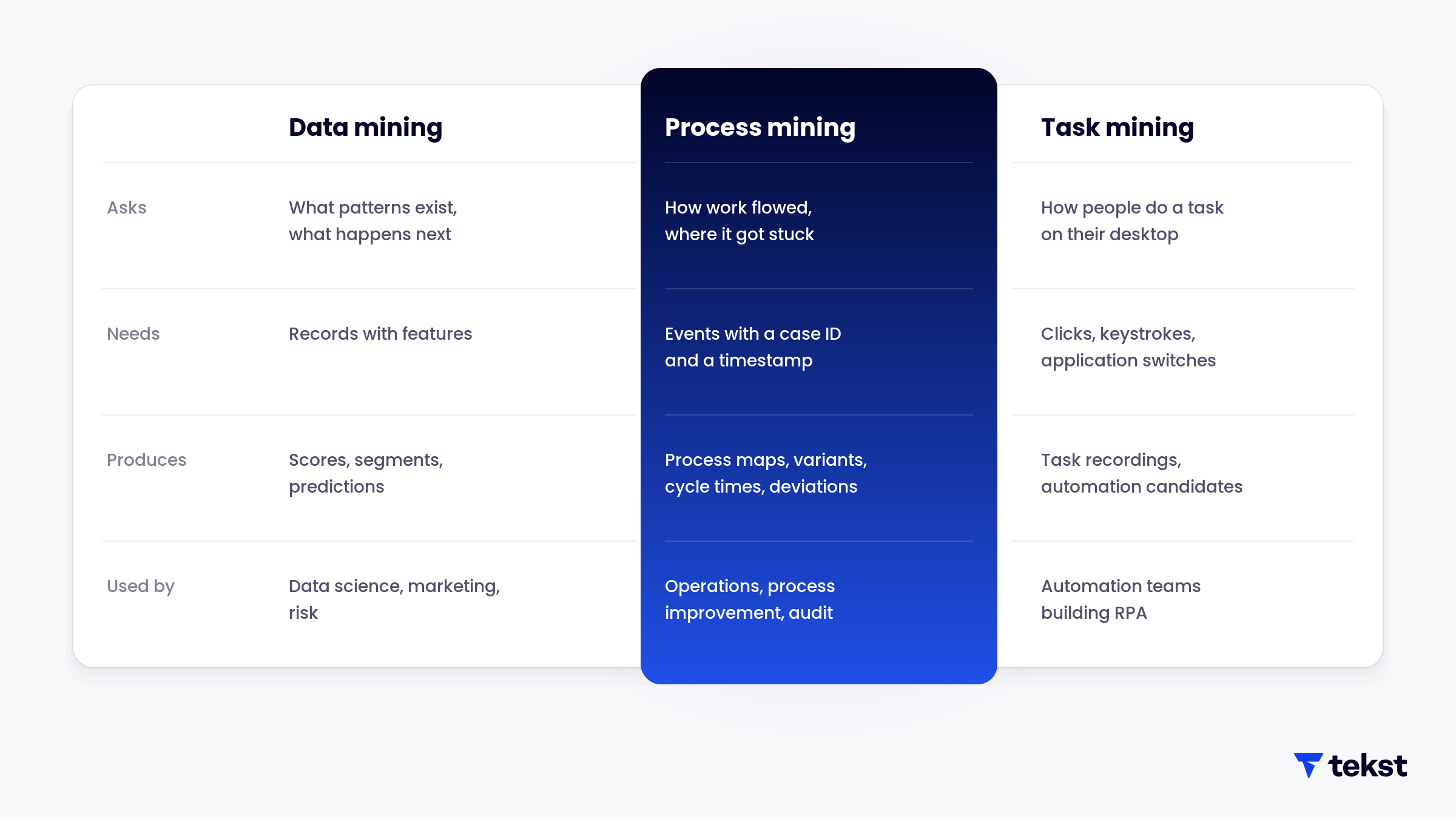
The question. Data mining asks what patterns exist in the data and what is likely to happen next. Process mining asks how work flowed and where it got stuck.
The data. Data mining works on records with features. Process mining needs events with a case identifier and a timestamp, so it can put them in order. A table of orders with their values is enough for data mining. Process mining needs to know what happened to each order, and when.
The output. Data mining produces scores, segments, predictions and rules. Process mining produces a process map, variants, cycle times and deviations from the intended process.
The users. Data mining is mostly the work of data scientists and analysts in marketing, finance and risk. Process mining is mostly used by operations, process improvement and audit teams.
Wil van der Aalst, who leads much of the research in the field, wrote in 2012 that classical data mining techniques "do not focus on business process models" and are often used to analyse only one step of a process. Process mining looks at the process end to end.
One dataset, two questions
The difference is easiest to see on the same data.
Take a year of order-to-cash data from an ERP: orders, deliveries, invoices and payments.
A data mining question: which orders are likely to be paid late? A model trained on order value, customer, region, payment terms and history might find that a certain combination of features predicts late payment. The answer is a score per order and a list of the features that matter.
A process mining question: why are orders paid late? The event log shows that a share of late payers went through a credit block, a manual release and a changed delivery date before the invoice was sent. The answer is a path, the time each step adds, and the point in the process where it goes wrong.
Both answers are useful. The first tells you which orders to watch. The second tells you what to change. In practice they work best together: process mining finds the problem variant, data mining predicts which new cases are heading into it.
Where task mining fits
Task mining is a third, related discipline. It records what people do on their desktops, such as clicks, keystrokes, application switches and copy-paste, and turns that into a picture of how individual tasks are performed.
Where process mining sees the steps a system records, task mining sees the work a person does between those steps. It is typically used to find repetitive desktop work for RPA, and it needs careful handling of privacy, because it observes employees directly.
There is a fourth source that neither covers well: communication. Many processes start with an email, a PDF or a chat message, and the decisions made while reading them leave no event in the ERP and no useful trace on the desktop. Conversation mining reads those messages as process data, which is how the part of a process that happens in the inbox becomes visible.
Data mining vs process mining in practice: using both
Modern process mining platforms use data mining techniques inside the process view:
- Clustering groups cases with similar paths, which separates the clean majority from the exceptions.
- Classification predicts which open cases will breach a service level or end in rework.
- Decision trees find the case attributes, such as customer, plant or product group, that the slow variants share.
The order matters. Process mining first establishes what happened; data mining then explains and predicts within that picture. Run the other way round, data mining finds correlations without showing where in the process they arise.
Data mining or process mining: which do you need?
Choose data mining when the question is about records and outcomes: who, what, how likely. Customer analytics, fraud detection, pricing and demand forecasting are its home ground.
Choose process mining when the question is about how work flows: why it is slow, where it deviates, what to automate, whether a change worked. Order-to-cash, procure-to-pay, claims and service operations are where it is used most. See process mining use cases and examples for how that looks by function.
Use both when you want to know not only where a process goes wrong, but which new cases are about to.

Discover the impact of AI on your enterprise. We're here to help you get started.