What Is Deduction Management in B2B, and How Do You Automate It?

A customer pays $9,200 against a $10,000 invoice. No note, no reason code, nothing. This is the daily reality of deduction management: someone in finance spots the short payment, opens a case, emails the customer, and waits two weeks for a reply. Then the digging starts: pull the original order, find the proof of delivery, match it to the invoice, chase a colleague for sign-off. Multiply that by 300 short payments a month across pricing disputes, shortage claims, and promotional allowances, and deduction management quietly consumes a finance team.
What is deduction management?
Deduction management is the process of identifying, classifying, investigating, and resolving deductions, meaning the situations where a customer pays less than the invoiced amount. In B2B commerce, common deductions include pricing disputes, short-ship claims, promotional allowances, and chargeback penalties. Managing them efficiently means capturing the deduction, categorizing it by type, gathering the supporting evidence, and routing it to the right owner before a resolution is approved.
Deduction management sits inside the wider quote-to-cash (Q2C) process, often used interchangeably with order-to-cash (O2C), which runs from a customer's first quote request to the resolution of the final dispute. Deductions are the last phase of that process, and they are where errors from every earlier phase tend to surface.
What is dispute resolution automation?
Dispute resolution automation is the use of AI to handle the early, repetitive stages of the deduction process, identification, classification, case creation, and evidence gathering, so the manual work that delays resolution disappears. It does not make the resolution decision itself; it removes everything that stands between a deduction arriving and an analyst being ready to resolve it.
The most common types of B2B deductions
Deductions fall into two broad groups. Trade deductions are agreed in advance: promotional allowances, advertising support, rebates, and volume discounts, usually set up by sales and covered by a trade budget. Non-trade deductions are not anticipated: shortages, damaged goods, returns, and pricing discrepancies between what was quoted and what was invoiced.
Chargebacks are a specific subtype. A chargeback is a penalty a large retailer deducts when a supplier fails to meet a shipping, labeling, packaging, or EDI requirement defined in the vendor agreement. Each type carries different evidence requirements, different timelines, and a different internal owner, which is exactly why classification is the first real bottleneck. Until you know what kind of deduction you are looking at, you cannot route it or pull the right proof.
Why deduction management fails at scale
Three things break when deduction volumes climb.
First, deductions arrive as unstructured communication. A short payment shows up on a remittance, a claim lands as an email with a PDF attached, and none of it is machine-readable. No ERP or accounts receivable system can read that email, so a person does.
Second, classification is manual. An analyst reads each notice and decides whether it is a pricing dispute, a shortage, or a compliance chargeback. That judgment determines everything downstream, and it happens one email at a time.
Third, evidence gathering is fragmented. The proof of delivery sits in the transport system, the invoice in the ERP, the original order in the order management system. Assembling one case file can take hours. At 100 deductions a month this is a full-time job; at 500 it is a team. And the cost is not only labor. Industry research puts deductions at 5 to 15 percent of invoice value in some sectors, and only a small share of claims, often cited at 3 to 5 percent, are ultimately invalid, yet every one still has to be researched one by one to find them.
What can be automated in B2B deduction management
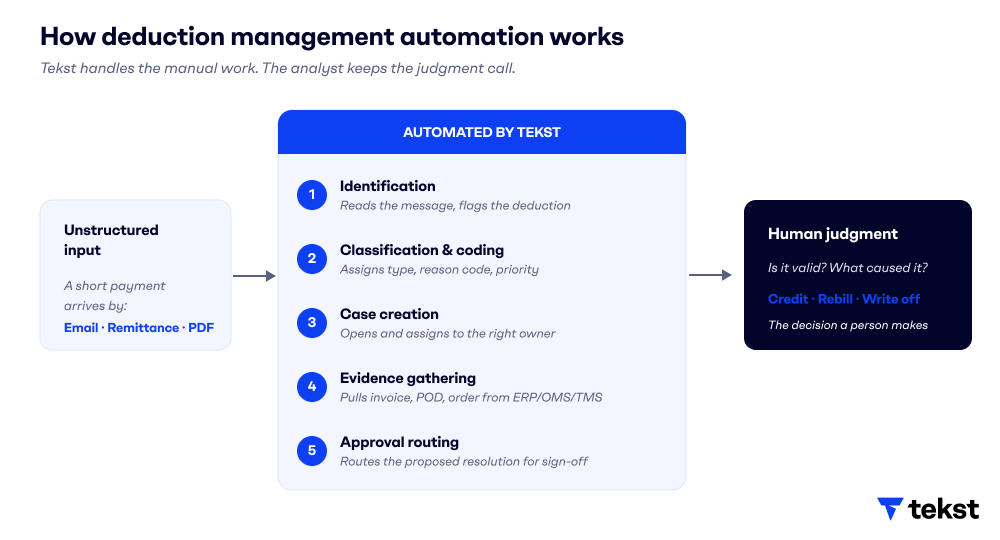
The work splits cleanly into two parts: the administration, which is repetitive and rule-based, and the judgment, which genuinely needs a person. Tekst automates the first so your analysts spend their time only on the second. Here is what that looks like.
- Identification. Tekst reads incoming emails and payment remittances, recognizes a deduction, and flags it automatically. No manual triage.
- Classification and coding. It assigns the deduction type, reason code, and priority based on the content of the message and historical patterns, so each case is sorted correctly from the start.
- Case creation and ownership. A structured case is created automatically and assigned to the correct owner based on type and amount.
- Evidence gathering. Tekst pulls the relevant records from the ERP, OMS, and transport system, the invoice copy, the delivery confirmation, the original order, and attaches them to the case.
- Approval routing. Once an analyst proposes a resolution, Tekst routes it through the correct approval chain based on amount and type.
What stays with people is the call that should stay with people: whether a deduction is valid, what the root cause is, and whether to credit, rebill, or write it off. Those are judgment decisions, and an analyst makes them faster and better when the case file is already complete. Tekst does not replace the analyst. It removes everything that was standing between the analyst and the decision.
This is the difference between Tekst and a generic OCR tool or a rigid RPA bot. Tekst runs on custom-trained AI built on your customers, your products, and your edge cases, so it reads the messy, non-standard communication that breaks template-based tools the moment a format changes.
The evidence problem
The single biggest time cost in deduction management is assembling evidence. Take a pricing dispute: the proof trail runs from the original quote and its acceptance, through the purchase order and the delivery confirmation, to the invoice. Five documents, four systems, one analyst clicking between them. Automating evidence gathering means that chain is pulled together and presented as one structured case file before anyone opens it. That alone turns a multi-hour research task into a review.
Where deduction management fits in quote-to-cash
Deductions are not an isolated finance problem. They are the feedback loop of the whole quote-to-cash process. A wrong quantity at order entry becomes a shortage claim. A pricing mismatch on the quote becomes a pricing deduction. Resolving deductions faster matters, but resolving them upstream matters more, and the same intelligence layer that reads order emails reads dispute notices. The cleaner the front of the process runs, the fewer deductions reach the back.
What results look like
There is no separate magic to deductions. The underlying pattern, unstructured communication turned into structured data and pushed into the system of record, is the same one Tekst already runs at scale in the order phase, where Dossche Mills reached over 95% classification accuracy and €100k in net annual savings on order routing and entry into SAP. Applied to deductions, that pattern attacks the three failure modes directly: classification time, case creation time, and evidence gathering time all collapse, without adding headcount.
Conclusion
Deduction management will not disappear. It is structural to B2B commerce. The real question is what your people spend their time on: the judgment calls that protect margin, or the administration that surrounds them. Reading emails, opening cases, and hunting for documents is work that no longer needs a person. Deciding what a deduction means still does. Automation handles the first so your team can own the second.

Discover the impact of AI on your enterprise. We're here to help you get started.