Agentic Process Automation Tools: Types, Criteria and How to Choose

Agentic process automation tools are software platforms that use AI agents to carry out multi-step business processes across systems. Instead of following a fixed script, the agent reads each incoming case, decides what needs to happen within the rules it has been given, acts in systems such as SAP or Salesforce, and hands anything uncertain to a person.
The category is crowded and confusing. RPA vendors, workflow platforms, integration platforms and AI start-ups all now describe their products as agentic. Gartner has a name for part of this trend: "agent washing", the rebranding of existing products without real agentic capability. In June 2025 it estimated that only about 130 of the thousands of vendors claiming agentic AI actually offer it, and predicted that over 40% of agentic AI projects will be cancelled by the end of 2027. This guide explains what separates an agentic process automation tool from a relabelled one, compares the five types of tools on the market, and sets out the criteria and questions that help you choose.
What makes a tool an agentic process automation tool?
Agentic process automation (APA) applies AI agents to whole business processes rather than single tasks. A tool earns the label when it can do four things.
- Understand unstructured input. Most operational work arrives as emails, PDFs, spreadsheets and tickets. An agent has to read them, work out what each one is about and extract the data it needs, without a template per sender.
- Decide within context. The agent chooses the next step based on the case in front of it: the customer, the order history, the rules, the exceptions. A fixed decision tree is not an agent.
- Act in your systems. It creates the sales order, updates the case, drafts the reply or routes the request, in the systems the business already runs on.
- Know when to stop. It escalates uncertain cases to a person, records why it did what it did, and improves from the corrections.
The difference from robotic process automation is the second point. RPA follows the path someone mapped in advance and breaks when reality takes a different one. The comparison between APA and RPA covers that in more detail. The broader term, agentic automation, also includes agents that handle single tasks; APA is the process-level version.
The five types of agentic process automation tools
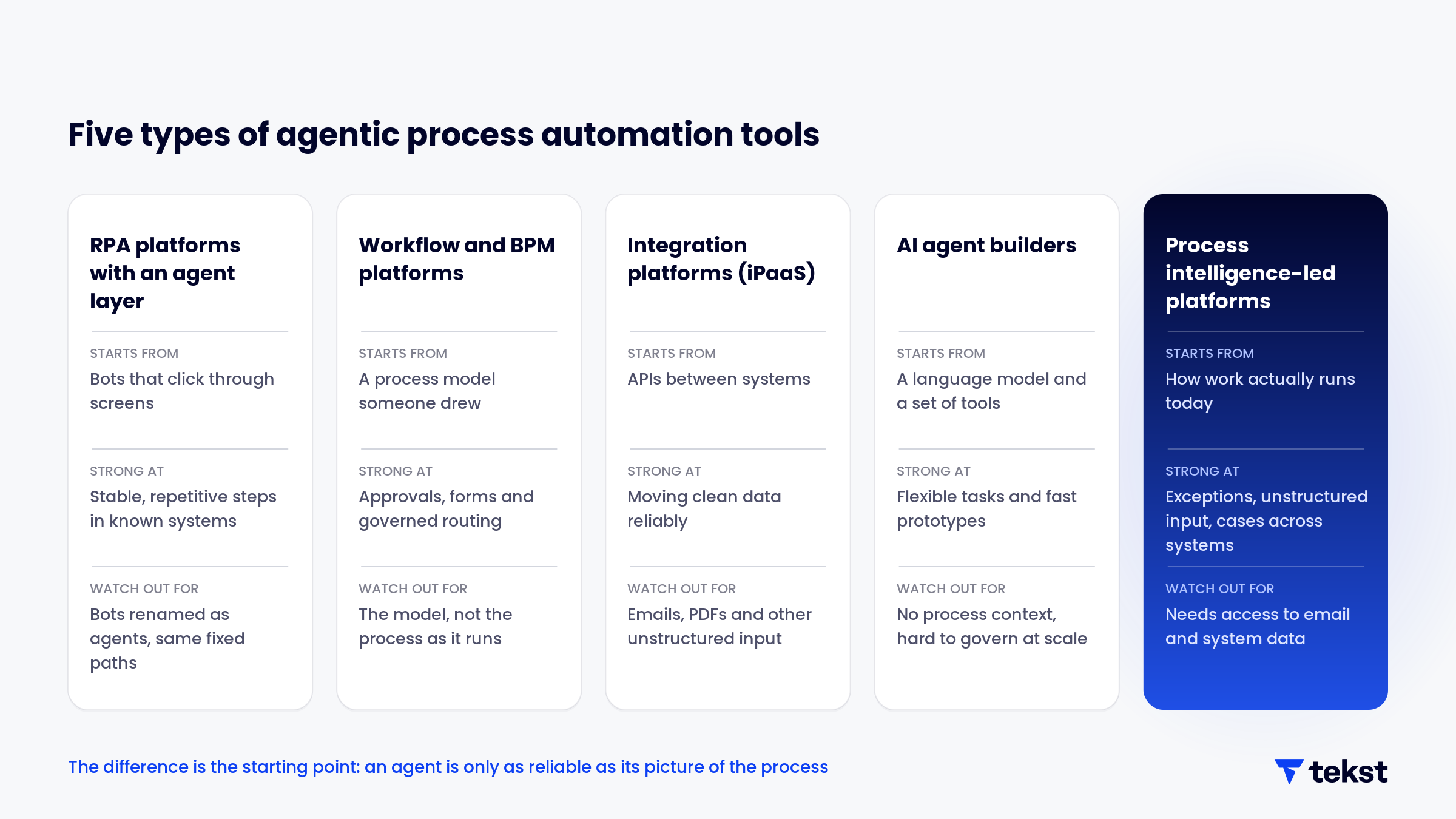
Almost every tool in this market started somewhere else and added agents later. Where a tool started tells you most about what it does well and where it struggles.
1. RPA platforms with an agent layer
The established robotic process automation vendors have added language models and agent builders on top of their bot platforms. They are strong where the steps are stable and the systems are known, and many enterprises already run them. The risk is architectural: if the agent still drives the same screen-level bots underneath, it inherits their brittleness. Renaming a bot an agent does not change what happens when an invoice arrives in an unfamiliar layout.
2. Workflow and BPM platforms
Business process management and low-code workflow tools start from a process model: forms, approvals, routing rules. Adding agents lets them handle some of the steps inside that model. They are strong on governance and approvals. Their limit is that the model is drawn by people, so it reflects the process as designed, not the variants and exceptions that make up much of the real work.
3. Integration platforms (iPaaS)
Integration platforms connect systems through APIs and move data between them reliably. Agentic features let them make simple decisions along the way. They work well once the data is clean and structured. They struggle with the step before that: turning an email with an attached PDF into data at all. The article on APA versus EDI and iPaaS explains why the two are complementary rather than competing.
4. AI agent builders
Developer frameworks and agent builders let a team combine a language model with tools and instructions. They are flexible and fast for prototypes. In production, two gaps tend to appear: the agent has no reliable picture of the process it works in, and governance, versioning and audit have to be built around it. That is where many of the projects Gartner expects to be cancelled get stuck.
5. Process intelligence-led platforms
This type starts from how work actually runs today. It reads communication and system data to build a model of the process first, including volumes, variants and exceptions, and then lets agents act inside that model. The strength is context: the agent knows which case it is handling, what usually happens next and when something is unusual. The requirement is access to the data where the process lives, which means connecting mailboxes and business systems with the right security controls. Process intelligence and APA work as two halves of the same loop: one sees, the other acts.
How to evaluate agentic process automation tools
Feature lists in this market look alike. These eight criteria separate tools that work in production from tools that work in a demo.
- Process visibility before automation. Can the tool show you how the process runs today, with real volumes and variants, before you automate anything? Without that, you are choosing what to automate on assumptions. Automated process discovery makes this a matter of days rather than a consulting project.
- Unstructured input. Test it on your own emails, attachments and languages, not on vendor samples. Ask how it handles a format it has never seen.
- Exceptions and human review. Every process has cases the agent should not decide alone. Look for confidence thresholds, a clear review step and the ability to approve or correct in the tools people already use.
- Actions in your systems. Check that the tool writes to the systems you run, such as SAP, Salesforce, Microsoft Dynamics, Oracle or ServiceNow, and what it needs from IT to do so.
- Governance and audit. Version history, rollback, testing before publishing, and a record of every decision the agent took and why. Auditors and IT will ask for all of it.
- Accuracy on your data. Ask for accuracy measured on a sample of your own cases, per step, not a general benchmark.
- Time to value. A realistic target is visibility of the process within days and first automations live within weeks. Be wary of plans that need months of configuration before anything runs.
- Pricing model. Per-seat, per-bot, per-token and per-outcome pricing behave very differently at scale. Make sure you can see what each automated step costs and that testing is not billed as production.
Questions to ask vendors
These questions help expose agent washing quickly.
- What happens, step by step, when an email arrives in a format your system has never seen?
- How does the agent know which customer, order or case a message belongs to?
- Which decisions does the agent take on its own, and which does it send to a person?
- Can we see the accuracy per step on our own data before we sign?
- How do we test a change, approve it and roll it back?
- What does it cost to process one case end to end?
A vendor with a real agentic architecture will answer these concretely. Vague answers about "AI that learns" are a signal to look further.
Where Tekst fits
Tekst is a process intelligence-led platform. It connects to inboxes, ERP and CRM, maps how work actually flows, and builds a context graph of the process before any agent acts. The agentic automations then execute in the systems customers already use, such as Outlook, SAP and Salesforce, and uncertain cases go to a person through the Tekst Sidepanel, which shows the email, the extracted data and one button to approve.
On the criteria above: full process visibility typically arrives in under 10 days, and first automations go live in weeks. Automations are checked before they are published, every change is saved as a version that can be rolled back, and teams can build automations from AI assistants such as Claude, ChatGPT or Copilot through the Tekst MCP, where publishing always needs a person's confirmation. Pricing is based on event volume for process intelligence and on credits per automated step, with free test runs.
Two examples from the order and service desk. Dossche Mills reached over 95% classification accuracy on its customer service and order emails across EMEA, with €100k in net annual savings. Becton Dickinson went live within three weeks and handles 1.4 million inquiries a year in more than 15 languages, with first response time down from three days to 22 hours. Typical starting points are order intake, AI order processing and the wider area of quote-to-cash automation.
How to choose an agentic process automation tool
Start with one process that carries real volume and arrives mostly as unstructured communication: an order inbox, a customer service mailbox or a claims queue. Map how it runs today before you pick a tool, so you know which request types carry the volume and which ones are simple enough to automate first.
Then shortlist two or three tools from different types, and run each on a sample of your own cases. Compare accuracy per step, the effort to handle exceptions and the cost per case. The tool that wins on your data is the right one, whatever the category label says.


Discover the impact of AI on your enterprise. We're here to help you get started.