What Is Agentic Automation? Definition, How It Works and Examples

Agentic automation is automation in which AI agents are given a goal rather than a script. The agent reads the situation, decides what needs to happen, acts across business systems and checks the result, escalating to a person when a decision falls outside its limits. Traditional automation follows the steps someone mapped in advance. Agentic automation works out the steps itself, within boundaries the business sets.
Interest is high. According to Gartner's 2026 CIO and Technology Executive Survey, only 17 percent of organisations have deployed AI agents so far, yet more than 60 percent expect to within two years. The results are less certain. In June 2025 Gartner predicted that over 40 percent of agentic AI projects would be cancelled by the end of 2027, because of rising costs, unclear business value or weak risk controls.
What is agentic automation?
Three properties separate agentic automation from earlier automation.
It starts from a goal. "Process this order change" instead of "copy field A to field B, then click submit".
It handles unstructured input. Emails, PDFs, chat messages and free-text notes, which rule-based tools cannot read reliably.
It decides and acts. The agent does not stop at a recommendation. It updates the ERP, replies to the customer or routes the case, and it records why.
What agentic automation is not: a chatbot that answers questions, or an assistant that drafts text for a person to send. Both are useful. Neither completes work on its own. Gartner calls the relabelling of such products "agent washing", and in 2025 estimated that only about 130 of the thousands of vendors claiming agentic AI are real.
How agentic automation works
Most descriptions of agentic automation use the same cycle: perceive, reason, act, learn. It is a fair summary, as long as each step is read in business terms rather than technical ones.
Perceive. The agent takes in a signal. In an operations team that is usually a message: a customer email, a supplier confirmation, a ticket, an attachment. It also reads the relevant records from the systems it is connected to.
Reason. The agent works out what the signal means and what should happen. Which customer is this? Which order? Is the requested change allowed, possible and within the agent's authority? This step relies on large language models, because they can interpret language that no template anticipated.
Act. The agent executes. It changes the delivery date in SAP, updates the case in Salesforce, sends the confirmation, or hands the case to a person with the context already assembled.
Learn. The outcome is recorded. Was the action correct? Did a person override it? That feedback is used to refine the agent's rules and instructions, and over time it shows which kinds of work the agent can take on next.
The cycle looks simple. Most projects that stall fail at the reasoning step, because the agent lacks context about the process.
Agentic automation vs RPA and traditional automation
The clearest way to understand agentic automation is to set it next to what came before.
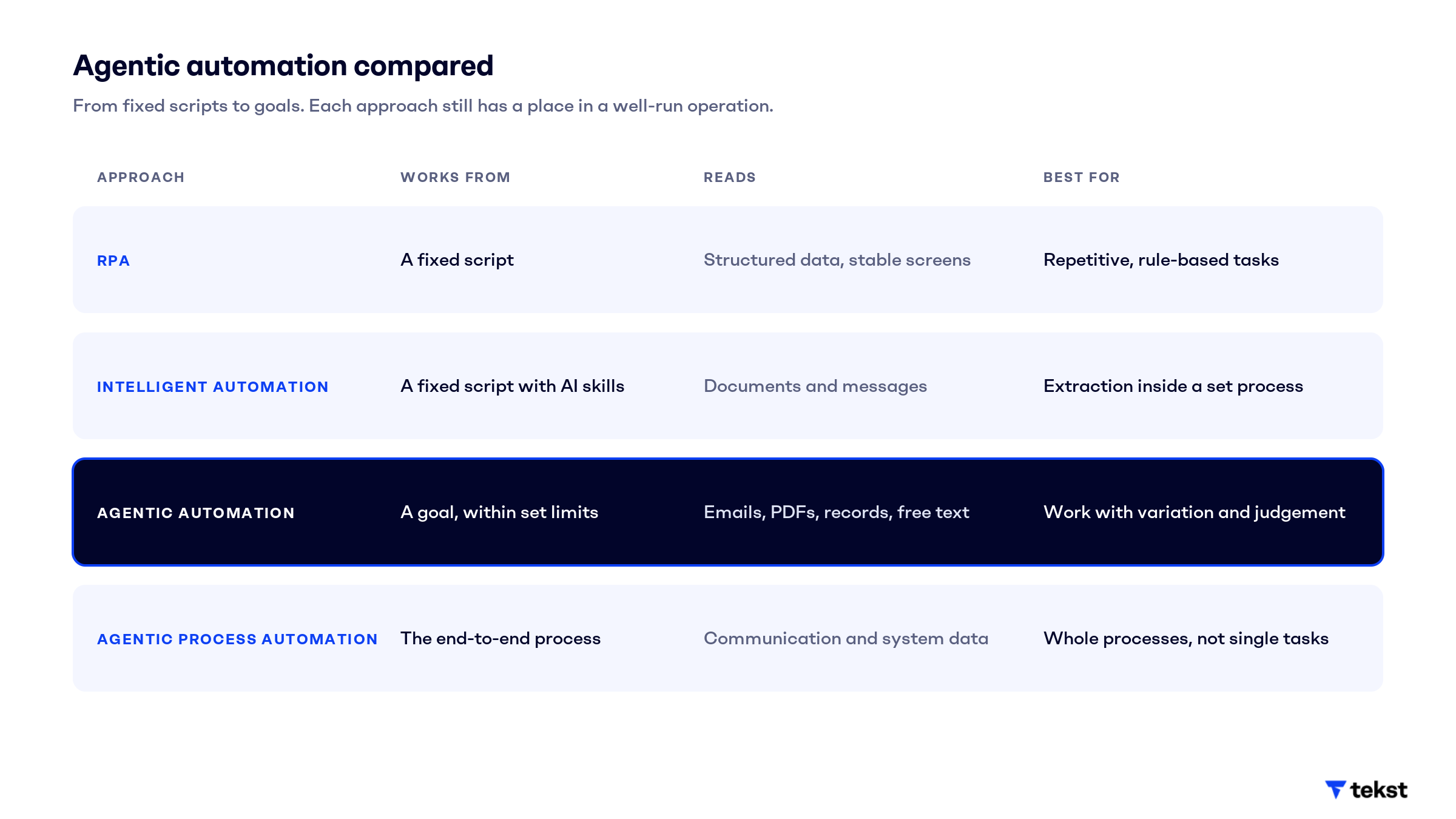
Robotic process automation (RPA) follows a fixed script. It is fast, cheap and reliable for structured, repetitive tasks, such as moving data between two systems with stable screens. It breaks when the input changes: a new invoice layout, a handwritten note, an email in German instead of English.
Intelligent automation adds AI skills to that script. Document extraction, classification and sentiment analysis let a bot handle messier inputs. The process itself is still defined by a person, step by step.
Agentic automation removes the fixed script. The agent is told what outcome is needed and decides which steps to take, which systems to query and when to stop and ask. That makes it suited to work with variation and judgement in it, and less suited to work that is already predictable.
That last point matters. Agentic automation does not replace RPA. Gartner's own advice is to use agents where decisions are needed, automation for routine workflows and assistants for simple retrieval. A well-designed operation uses all three. An agent that decides an order change is acceptable may hand the actual system update to a deterministic workflow, because that step should behave identically every time.
Agentic automation, agentic AI and agentic process automation
Three terms circulate, often interchangeably. They are related but not the same.
Agentic AI is the technology: AI systems that can plan, use tools and act with some autonomy. It is the broadest term and covers everything from coding agents to research agents.
Agentic automation is the application of that technology to business work. It is what happens when agentic AI is pointed at a process with a defined outcome, inside a company's systems and rules.
Agentic process automation goes one step further and treats the end-to-end process as the unit, not the individual task. It combines an understanding of how the process actually runs with agents that execute it, so automation decisions follow the real flow of work rather than a diagram of it.
Put simply: agentic AI is the capability, agentic automation is its use in operations, and agentic process automation is its use across a whole process.
Agentic automation in practice: one email, start to finish
Definitions only go so far. Here is what agentic automation looks like in a typical operations team.
A distributor's customer service inbox receives an email from a buyer at a food manufacturer. The order number is in the subject line, but with a typo. The message asks to move delivery forward by four days and to increase one product line from 20 to 26 pallets. It ends with "same terms as last time".
Without automation, a customer service employee reads the email, searches SAP for the order, checks stock and the delivery schedule, asks planning whether the earlier date is feasible, looks up what "same terms as last time" referred to, updates the order, and replies. It can take most of an hour, spread across a day of waiting for answers.
With RPA, nothing much changes. The email does not match a template, so the bot either fails or routes it to the same person.
With agentic automation, the agent classifies the email as an order change, matches the mistyped order number to the correct order using the customer and product lines, and checks stock and transport capacity for the new date. It reads the previous order to understand the terms the buyer referred to. If the change is within policy, it updates the order, confirms to the customer and logs every step. If the extra pallets push the order over the customer's credit limit, it stops and passes the case to a person, with the order, the requested change and the reason for escalation already on screen.
The difference is not speed alone. The person who used to do all of this now handles only the cases that need judgement, and every case leaves a structured record behind. Order change management is one of the processes where that shift is most visible, because almost every change starts as a message.
Agentic automation examples by function
The same pattern, a message in and an action out, repeats across most operational functions.
Order management. Order intake from email, PDF and EDI, order changes and cancellations, delivery date requests. Before automating order intake, Mitsubishi Chemical Group found that 60 percent of orders required manual entry and consumed 20 percent of inside sales time, while the template-based OCR in place handled only 4 percent of orders.
Customer service. Classifying, prioritising and routing incoming requests, enriching the case with order and customer data, drafting or sending replies. BD, the medical technology company, handles 1.4 million inquiries a year in more than 15 languages. After classification and routing were automated, SLA compliance for product incident reporting rose from 13 to 97 percent.
Finance. Invoice intake and matching, payment queries, deduction and dispute handling, where most of the work is reading what the customer meant.
Procurement and supply chain. Supplier confirmations, revised delivery schedules and exception handling when a shipment slips.
IT operations. Ticket triage, diagnostics and routine fixes. In McKinsey's 2026 State of AI survey, IT, knowledge management and software engineering are where respondents most often report scaling agents.
Why agentic automation projects stall
If agentic automation works, why does Gartner expect so many projects to be cancelled? Gartner's research points to the first two causes. Experience points to a third.
The use case did not need an agent. Gartner notes that many use cases positioned as agentic do not require agentic implementations. A stable, rules-based task automated with an agent costs more and behaves less predictably than the same task automated with a workflow.
The value was never defined. Agents were deployed as experiments, without a baseline or an outcome to measure. McKinsey's State of AI 2026 shows the gap: among organisations with more than $1 billion in revenue, the share scaling AI agents rose from 27 to 40 percent in a year, while the share of all respondents reporting any EBIT impact from AI was essentially unchanged, at 37 percent. The same survey finds AI high performers twice as likely as others to have defined processes for measuring the impact of their AI initiatives.
The agent did not understand the process. This cause gets the least attention. An agent reasons over whatever context it is given. If it does not know which steps a process really has, which exceptions occur, who decides what and where cases usually stall, it will make confident decisions on an incomplete picture.
McKinsey's data hints at the fix. Nearly three quarters of AI high performers, about 6 percent of respondents, report fundamentally redesigning workflows because of their AI use, compared with about a quarter of other respondents. McKinsey describes high performers as redesigning workflows rather than inserting AI into existing ones. Redesign starts with knowing how the process runs today.
What an agent needs to know before it acts
An agent in an operations team needs three kinds of knowledge that a foundation model does not bring.
How the process actually runs. Not the version on the process map, but the real one: the variants, the common exceptions, the handovers between teams. Gartner's 2026 Hype Cycle for Agentic AI lists context graphs among the emerging practices for building and managing agentic systems. Process intelligence is the discipline that produces that picture.
What the company's language means. Product names, customer shorthand, internal codes, the difference between "urgent" from one customer and "urgent" from another. Generic models guess. Models adapted to a company's own communication guess less.
Where the boundaries are. Which decisions the agent may take alone, which need approval, and which it should never touch. These rules turn autonomy into something an operations leader can sign off on.
There is a reason the first of these is hard to get. Most process knowledge is not in the ERP. It sits in email threads, shared mailboxes and the heads of experienced staff, which is why process intelligence needs to start in the inbox. An agent that only reads system records sees the outcome of each decision, not the reasoning that produced it.
Where to start with agentic automation
Start with a process that has three things: high volume, real variation and a clear outcome. Shared mailboxes for orders, changes, claims or service requests usually qualify, because the volume is easy to count and the variation is what has kept them manual.
Measure the baseline before deploying anything: volume, handling time, error rate, service level. Then map how the process really runs, including the exceptions, before deciding which parts an agent should own.
Begin with the agent proposing and a person approving. Move decisions to full autonomy one category at a time, as accuracy is proven on real cases. Keep deterministic automation for the steps that should never vary.
Agentic automation is not a new name for RPA, and it is not a chatbot with system access. It is a way of handing judgement-heavy work to software, which only works if the software understands the work as well as the people who did it before.
Discover the impact of AI on your enterprise. We're here to help you get started.