What Is Process Intelligence?
Process intelligence is the practice of reconstructing how work actually runs across an organisation, using operational data rather than documentation, and turning that picture into decisions and action. It covers the techniques that capture process data, the analysis that finds where work breaks down, and increasingly the execution layer that does something about it. Where a process map shows what a process is supposed to look like, process intelligence shows what it looked like last Tuesday at four in the afternoon, including the exception nobody wrote down.
The term matters more than it used to. Both Gartner and Forrester now treat process intelligence as the umbrella category rather than process mining, which sits inside it as one technique among several. Forrester evaluated fifteen vendors in The Forrester Wave: Process Intelligence Software, Q3 2025, naming ARIS, Celonis and iGrafx as Leaders. Gartner made the same move in Innovation Insight: Beyond Process Mining and Analysis, The Future Is Process Intelligence, published in September 2025. In 2026 it followed with Coolest Vendor Innovations in Process Intelligence, which examines six vendors, Tekst among them. The category has a name because enterprises stopped asking for prettier process maps and started asking what to do with them.
What is process intelligence?
Process intelligence is the capability to see, measure and improve how business processes are executed in reality, based on the data those processes leave behind.
Three things separate it from process documentation. It is evidential rather than descriptive, built from timestamps, system records and messages rather than from workshops. It is continuous rather than periodic, updating as work happens rather than at the end of a project. And it is operational rather than strategic, concerned with the order that sat untouched for nine days rather than with the org chart.
The practical test is simple. If your process map was drawn by a consultant and your process intelligence platform disagrees with it, the platform is right.
How process intelligence works
Every platform works in the same three stages, whatever the vendor calls them.
Capturing what actually happened
Every system involved in a process leaves a trace. An ERP records that a sales order was created, changed and released. A CRM records that a case was opened and reassigned. A ticketing system records a status change at 09:14. Individually these are meaningless. Collected across systems and ordered by time and by case, they become evidence.
The quality of everything downstream depends on this step, and it is where most implementations spend most of their effort. Event data has to be extracted, cleaned, and tied to a consistent case identifier so the platform knows that the quote, the order and the invoice are the same piece of work.
Reconstructing the real process
Once events are ordered, the platform rebuilds the actual paths work took. Not the one path in the handbook, but the hundreds of real variants: the standard route, the rush route, the route that happens when a customer emails a change after the order is released, and the route that only exists because one person in Antwerp has always done it that way.
This is usually where people first see the gap between the process they thought they had and the one they have.
Analysing where work breaks down
With the real process reconstructed, the analysis becomes concrete. Where does work wait, and for how long? Which steps get repeated? Which cases miss their service level, and what do those cases have in common? Which handovers between teams or systems cost the most time? Which variants are expensive enough to be worth removing?
Process intelligence vs process mining, task mining and business intelligence
These terms get used interchangeably, and they are not the same thing. The distinction is what each one looks at.
Business intelligence looks at aggregated outcomes: revenue, volumes, averages. It produces dashboards and KPIs. It cannot explain how a result was produced.
Process mining looks at event logs from transactional systems. It produces the real sequence of process steps, with timing. It cannot see work that never touches a transactional system.
Task mining looks at individual user actions on the desktop. It shows how people actually complete a step. It cannot show the process end to end across systems.
Conversation mining looks at emails, messages and documents. It surfaces the requests, decisions and exceptions buried inside communication. It cannot reconstruct system-side transactions on its own.
Process intelligence combines all of the above. It produces a continuous, evidence-based model of how work runs. It cannot change anything by itself.
Process mining is the best known of these, and the oldest. It emerged as an academic discipline led by Wil van der Aalst at Eindhoven University of Technology, and was formalised by the IEEE Task Force on Process Mining in its Process Mining Manifesto, published in 2012. Process intelligence is the broader category that grew around it once organisations realised event logs alone were not enough.
The part of the process most platforms cannot see
There is a gap in this category that almost nobody writes about.
Process mining reads structured events from systems of record. That works beautifully for the part of a process that happens inside SAP or Salesforce. It sees nothing at all for the part that happens in an inbox.
In most enterprise operations, a meaningful share of the real process lives in communication. The customer emails a change to a purchase order. A supplier attaches a revised schedule as a PDF. A regional sales manager forwards a query with “can you sort this out” and no further instruction. Someone reads it, decides what it means, and keys the result into a system. The system records the outcome at 14:32. It records nothing about the forty minutes of reading, deciding and chasing that produced it.
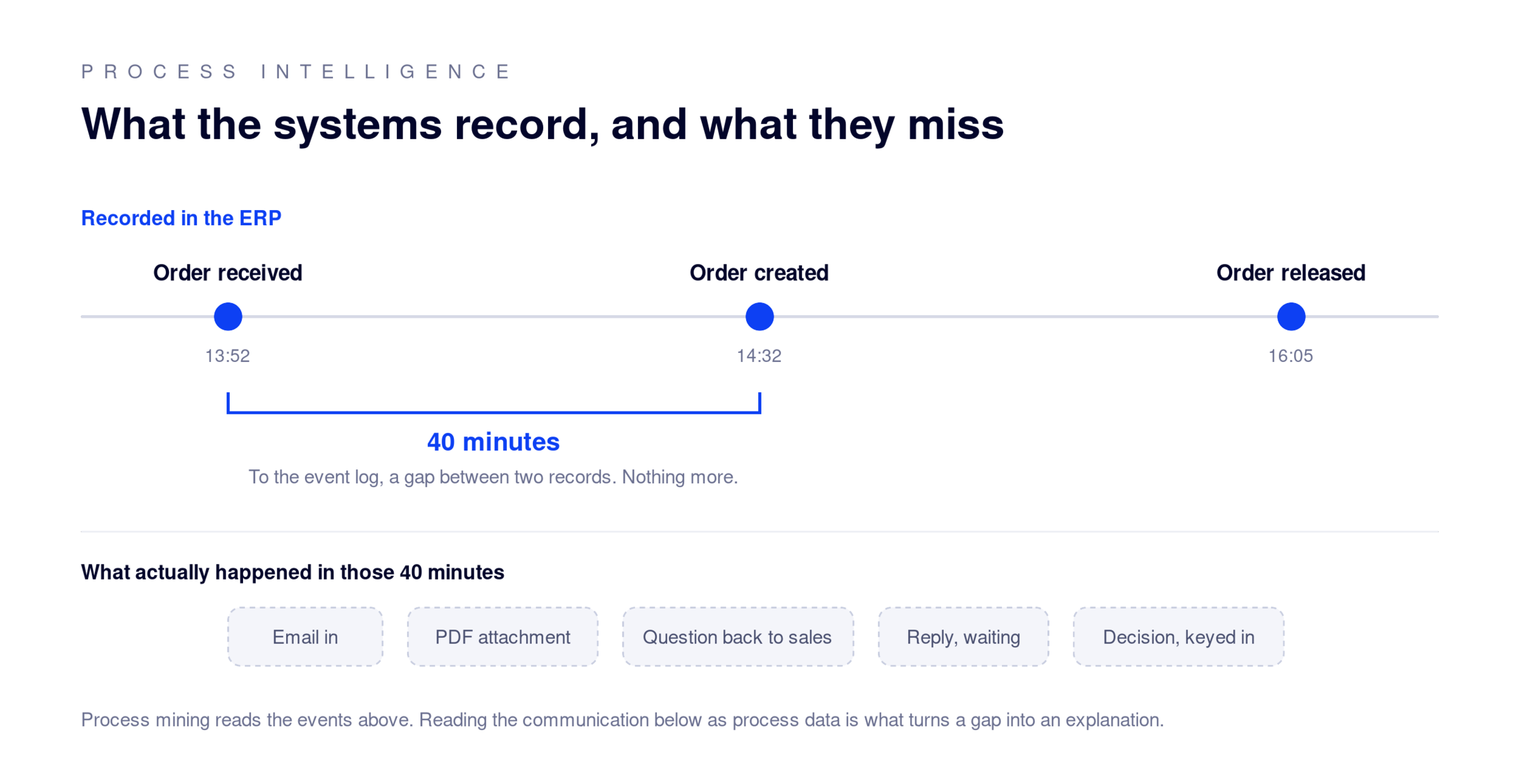
To a process mining tool, that forty minutes looks like a gap between two events. The analysis will correctly tell you there is a delay. It cannot tell you what happened in it, because the evidence is sitting in a shared mailbox in unstructured form.
This is why process intelligence that only reads transactional systems tends to produce accurate but shallow answers. It finds where the time goes and cannot say why. Reading the communication layer as process data, rather than as correspondence, closes that gap. It is the difference between knowing that order changes cause delays, and knowing which share of those changes arrives by email in a form nobody can act on without asking a question back.
What enterprises use process intelligence for
Four uses account for most of the value.
Finding where operations actually lose time. Not where leadership believes time is lost, which is usually one step later than where it really happens.
Deciding what to automate. Automating a process you have not measured is how organisations end up with fast versions of bad processes. Process intelligence establishes which variants are frequent enough and stable enough to be worth automating, and which exceptions will break a rules-based approach.
Proving compliance with how work is supposed to run. For regulated industries, the ability to show that a control was applied in every case, rather than in a sample, changes the nature of an audit.
Monitoring whether an improvement held. Most process improvement is measured once, at the end of the project. Continuous process intelligence shows whether the change survived contact with next quarter.
Why process intelligence became the foundation for AI agents
The category got a second life for a reason that has nothing to do with process improvement.
AI agents need to know how work runs before they can do any of it. An agent asked to handle an order change needs to know what a valid order change looks like in this company, which exceptions require a human, what the sequence is, and where the decision points sit. Without that, it is improvising against a system of record.
The evidence that this is a real constraint is not subtle. Gartner predicts that over 40% of agentic AI projects will be cancelled by the end of 2027, due to escalating costs, unclear business value or inadequate risk controls. Underneath all three sits the same question: whether anyone established how the work actually runs before pointing an agent at it. Gartner's own recommendation in that research is telling: in many cases, rethinking workflows with agentic AI from the ground up is the ideal path to successful implementation. Rethinking a workflow requires knowing what the workflow is.
That is what has moved process intelligence from a process improvement tool to a prerequisite. The organisations getting value from agents are the ones that mapped reality first.
What process intelligence cannot do on its own
Three honest limits, none of which the category's marketing tends to mention.
It does not change anything. Process intelligence produces understanding. Understanding does not reroute an order or answer a customer. Plenty of process mining programmes have produced excellent analysis that nobody ever acted on, because acting on it was a separate project with a separate budget. Visibility without execution is an expensive way to feel informed, which is why the category is converging with agentic process automation, where the analysis and the action sit in one loop.
It is only as good as its event data. If case identifiers are inconsistent across systems, or if the process runs partly outside any system, the reconstruction will be confidently wrong. The data engineering effort this requires is the single most underestimated part of most implementations.
It describes the past. A process model built from last year's events describes last year's process. In operations that change continuously, the model has to be rebuilt continuously, or it quietly becomes documentation again.
How to know whether you are ready
Process intelligence is worth doing when three conditions hold. The process spans more than one system, so nobody has the full picture. It runs at enough volume that small inefficiencies compound into real money. And someone has the authority to act on what the analysis finds.
If the third condition is missing, the analysis will be correct and nothing will change. That is not a technology problem, and no platform will solve it.
The short answer
Process intelligence is how an organisation replaces its assumptions about how work runs with evidence. It reconstructs real processes from the data those processes leave behind, in systems and in communication, and shows where work waits, repeats and fails.
It has become the foundation layer for enterprise automation because automation built on assumptions breaks, and AI agents built without process context get cancelled. The category is worth the attention it is getting. It is worth a lot less if the insight it produces has nowhere to go.
Gartner, Coolest Vendor Innovations in Process Intelligence, 2026. Gartner, Innovation Insight: Beyond Process Mining and Analysis, The Future Is Process Intelligence, September 2025. Forrester, The Forrester Wave: Process Intelligence Software, Q3 2025.
GARTNER is a registered trademark and service mark of Gartner, Inc. and/or its affiliates in the U.S. and internationally and is used herein with permission. All rights reserved. Gartner does not endorse any vendor, product or service depicted in its research publications and does not advise technology users to select only those vendors with the highest ratings or other designation. Gartner research publications consist of the opinions of Gartner's research organization and should not be construed as statements of fact. Gartner disclaims all warranties, expressed or implied, with respect to this research, including any warranties of merchantability or fitness for a particular purpose.

Discover the impact of AI on your enterprise. We're here to help you get started.