Process Analytics vs Process Intelligence: What's the Difference?
Process analytics and process intelligence are not rival technologies. Process analytics is a method: the measurement of how a process performed, using the event data that process left behind. Process intelligence is the wider capability that contains it, combining data capture, analysis and, increasingly, execution. The short version is that process analytics answers how long something took. Process intelligence answers what to do about it.
That distinction sounds academic until a vendor quotes you for one and delivers the other.
What is process analytics?
Process analytics is the application of analytical techniques to event data generated by the execution of business processes.
The clearest definition comes from the research literature rather than from vendors. Writing in Information Systems Frontiers, Lang, Misic and Zhao distinguish it from process mining directly: where process mining is concerned with the automatic discovery of process models, conformance analysis and enhancement, business process analytics focuses specifically on developing tools and methods for process enhancement, and usually analyses flow times, resource utilisation, costs and other indicators to aid process refinement, redesign and continuous improvement.
In practice, that means process analytics produces measurements. Average cycle time for a purchase order. The share of invoices that needed manual correction. How often a case was reassigned before it closed. Which of four hundred process variants accounts for most of the delay.
It is a discipline of questions with numerical answers: what happened, how often, how long, at what cost.
What is process intelligence?
Process intelligence is the capability to see, measure and improve how business processes are executed in reality, based on the data those processes leave behind.
It is a category rather than a technique. It covers the methods that capture process data, being process mining, task mining and conversation mining, the analysis applied to that data, and the monitoring, prediction and simulation built on top of it. Process analytics is one component inside that, not a synonym for the whole.
The category is now formally recognised. On 5 May 2026 Gartner published its first Magic Quadrant for Process Intelligence Platforms, replacing the Magic Quadrant for Process Mining Platforms it had run for the previous three years and widening the scope to platforms that unify mining, modelling, analysis, monitoring and automation discovery. Forrester had already moved the same way with The Forrester Wave: Process Intelligence Software, Q3 2025, which evaluated fifteen vendors. The naming shift is the point. Analysts stopped describing the technique and started describing the capability.
Process analytics vs process intelligence: the key differences
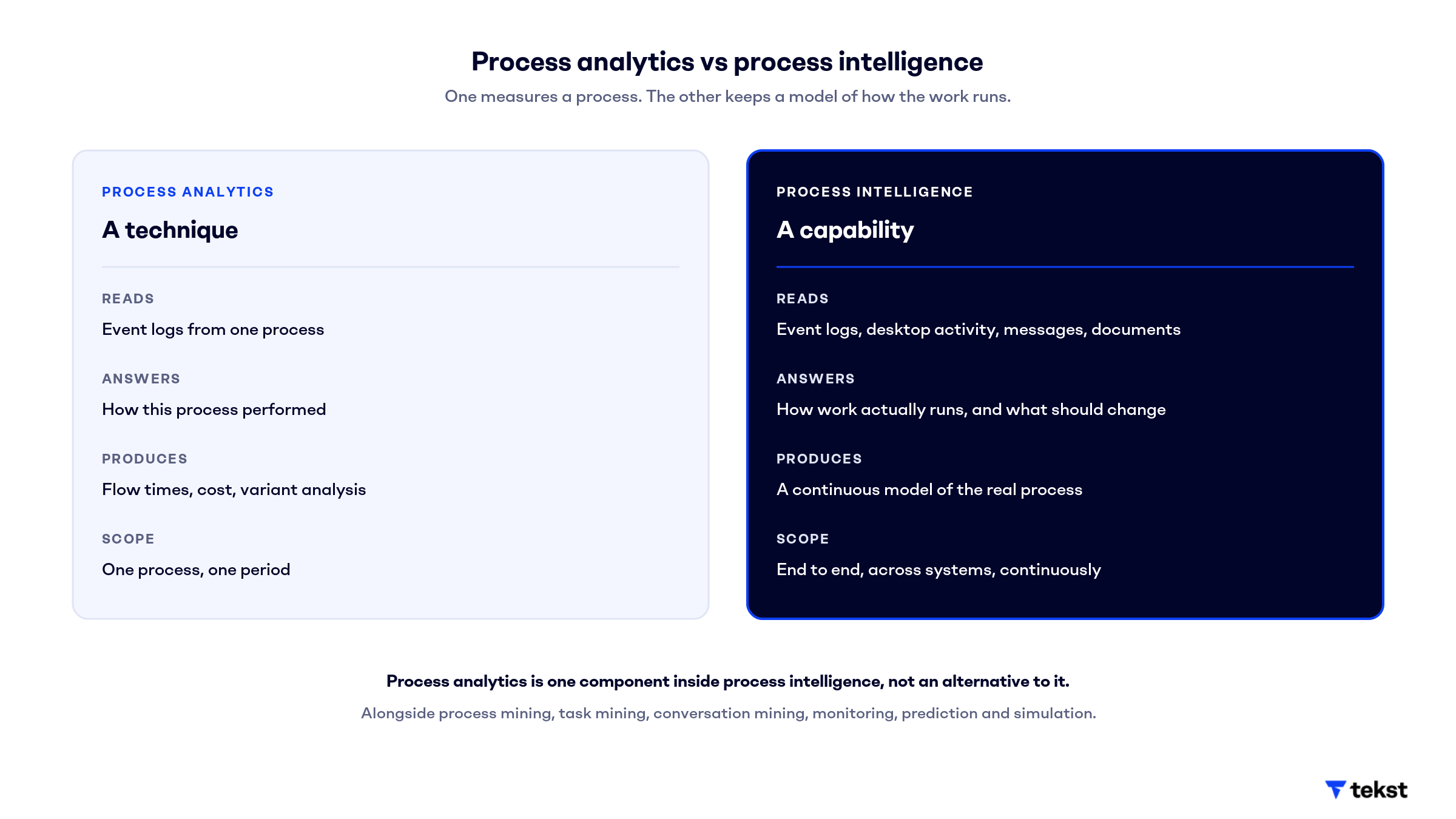
What they are. Process analytics is a technique you apply. Process intelligence is a capability you operate.
What they read. Process analytics works from event data belonging to one logged process. Process intelligence draws on event logs, desktop activity, messages, documents and system records together.
What they answer. Process analytics answers how a given process performed. Process intelligence answers how work actually runs across the organisation, and what should change.
What they produce. Process analytics produces metrics, distributions and variant analysis. Process intelligence produces a continuous model of the real process, with analysis and monitoring on top of it.
How far they reach. Process analytics usually covers one process over one period, and is owned by an analyst or a continuous improvement lead. Process intelligence runs end to end across systems and continuously, and is owned at operations or transformation level.
The cleanest way to hold the two apart: process analytics is something you do to process data. Process intelligence is what you have when capture, analysis and monitoring run together and keep running.
Why the two terms get confused
The first reason is genuine, and it catches people who have read around the subject. The academic and commercial definitions do not match. In the research literature, business process analytics is itself an umbrella term, described as the family of process-centric methods and tools that integrate process modelling, process data management, process mining and data analysis. That is close to what the market now calls process intelligence. In vendor usage, process analytics has narrowed to the measurement layer and process intelligence has taken the umbrella position. Both usages are current. Neither is wrong. They simply sit in different rooms.
The second reason is that positioning follows the market. When an analyst firm renames a Magic Quadrant, product pages follow within a quarter. Tools that do process analytics get relabelled as process intelligence platforms without gaining a single capability.
The third is that the buyer rarely gets to test the difference before signing. A dashboard showing cycle times looks identical in a demo whether it sits on a full intelligence layer or on a single exported event log.
There is a question that cuts through it. Ask what happens when the process changes next month. A process analytics tool produces a new report when someone runs it again. A process intelligence platform notices.
Where process analytics stops
Both disciplines share a dependency that almost nobody writes about. They can only measure what a system recorded.
Process analytics works on event logs. An ERP records that a sales order was created at 09:14, changed at 11:40 and released at 16:05. Those timestamps are excellent evidence, and everything downstream is built on them.
But consider what produced the 11:40 change. A customer emailed to move a delivery date. Someone read the mail, judged whether the new date was feasible, checked with planning, and keyed the result into SAP. The system recorded the outcome. It recorded nothing about the two and a half hours of reading, deciding and chasing that produced it.
To process analytics, that interval is a gap between two events. The measurement is correct, in that there was a delay of two hours and twenty-six minutes, and the explanation is missing, because the evidence is sitting in a shared mailbox in unstructured form.
This is where the distinction stops being semantic. A platform that reads communication alongside system events can attribute that gap. One that reads only event logs can measure it and nothing more.
From insight to execution
There is a second boundary, further along.
Neither process analytics nor process intelligence, in their classical definitions, change anything. They describe. The prescription is left to people and the implementation to a separate automation project, usually with a different budget and a different vendor. The pattern is familiar: a discovery phase produces findings, findings produce a business case, and eighteen months later the bottleneck is still there.
The direction of the category is to close that gap. Agentic process automation treats intelligence and execution as one loop rather than two projects. The model of the real process determines what gets automated, the automation generates new execution data, and that data updates the model. Analysis stops being a deliverable and becomes a running function.
That is an architectural difference rather than a naming one, and it is worth asking about directly. A platform that can only report is doing process analytics well. A platform that acts on what it found is doing something else.
Process analytics or process intelligence: which does your organisation need?
If you have one process, a clean event log and a specific question, such as why order entry takes eleven days in Germany and four in Belgium, process analytics is sufficient, and cheaper. Buy the analysis, get the answer, act on it.
If you have several processes across several systems and no reliable picture of how work moves between them, analytics on one log will not help. The measurement will be accurate and the conclusion will be wrong, because most of the delay lives in the handovers nobody logged.
And if a meaningful share of your process arrives as a message rather than a transaction, such as order changes, claims and supplier queries, then the deciding question is not analytics versus intelligence at all. It is whether the platform can treat communication as process data, or only as something that happens before the process starts.

Discover the impact of AI on your enterprise. We're here to help you get started.