SAP ECC End of Life: Why Process Mining Should Come Before Your S/4HANA Migration

In a migration workshop, the order team draws its process on a whiteboard. An order arrives, someone checks it, it goes into SAP, the customer gets a confirmation. Four boxes and three arrows. When the same process is rebuilt from data, an audit of 4,514 orders finds 1,314 different paths. One of those two pictures is about to be moved to SAP S/4HANA. Usually it is the whiteboard.
SAP ECC end of life refers to the end of mainstream maintenance for SAP ECC 6.0 on 31 December 2027. The system keeps running after that date, but standard support stops unless a company buys extended maintenance, which SAP offers until the end of 2030. For most SAP customers the real question is not whether to move to SAP S/4HANA, but how to move without carrying today's workarounds into the new system. This guide covers the dates, the options, and why process mining belongs at the start of a migration rather than at the end.
What is SAP ECC end of life?
SAP ECC (ERP Central Component) is the ERP core of SAP Business Suite 7. Many companies have run finance, sales, procurement and logistics on it for close to two decades. SAP has committed to maintaining its successor, SAP S/4HANA, until the end of 2040, and is phasing out maintenance for ECC in stages.
- End of 2025: Mainstream maintenance ended for older ECC 6.0 enhancement packages (EHP 0 to 5).
- 31 December 2027: Mainstream maintenance ends for the SAP Business Suite 7 core applications, including the latest three ECC 6.0 enhancement packages (EHP 6 to 8).
- 2028 to 2030: Optional extended maintenance, at a premium of two percentage points on the maintenance basis.
- 2031 to 2033: SAP ERP, private edition, transition option: a cloud subscription for large, complex customers that meet strict conditions.
These dates come from SAP's own maintenance strategy. The transition option is narrower than it sounds. Systems have to move to SAP ERP, private edition, on the SAP HANA database before the end of 2030, and SAP has stated plainly that the offering is not a maintenance prolongation of SAP ERP.
What happens to SAP ECC after 31 December 2027?
Nothing switches off. ECC runs on 1 January 2028 exactly as it did the day before. What changes is the support behind it.
Mainstream maintenance is what keeps an ERP current: legal and regulatory updates, security patches and standard support. Companies that buy extended maintenance keep that support for three more years at a higher fee. Companies that do not buy it move to what SAP calls customer-specific maintenance, which is narrower in scope, and carry more of the risk themselves.
The risk grows slowly rather than all at once. A tax rule changes and the update has to be built in-house. A security issue needs a workaround. The people who know the system well move on to S/4HANA projects, and ECC expertise gets scarcer and more expensive every year. The deadline is a date. The cost of missing it is a curve.
Your options after 2027
There are four routes, and most companies will combine them across their landscape.
- Move to SAP S/4HANA before the end of 2027. On premise, in a private cloud through RISE with SAP, or in the public cloud.
- Buy extended maintenance and finish the move by the end of 2030. This buys three years at a known premium.
- Use the transition option. Only for the largest and most complex landscapes, and only on SAP's conditions: a move to SAP ERP, private edition before 2030, and use until the end of 2033 at the latest.
- Keep ECC on third-party support. This keeps the current system running, but does not move it forward.
The options buy time. None of them removes the migration. For most companies the destination is SAP S/4HANA, and the open question is how much of the time they buy is spent preparing for it.
How long does an S/4HANA migration take?
Longer than the plan says. Gartner has worked with clients on migration projects of three to seven years, and estimated that at the end of 2024 only about 39% of the roughly 35,000 ECC customers had made the move, according to CIO.com. At that pace, Gartner projects around 17,000 companies will still run ECC in 2027, and 13,000 in 2030.
The projects that are under way often run late. In research by ISG among 200 senior decision-makers, nearly 60% of SAP migration projects were delayed and over budget. The reasons were underestimated complexity, scope creep and internal constraints that were not understood at the start.
Customers are adjusting their plans accordingly. In a survey by the German-speaking SAP user group DSAG, 37% of ECC users planned to switch by the end of 2027, while almost half planned to finish by the end of 2030. DSAG's chairman put it simply: they "need this time due to the complexity of their system landscapes".
Complexity is the word that keeps coming back. And most of that complexity sits in processes nobody has measured.
Greenfield, brownfield or selective: why each starts with the real process
There are three common ways to move from ECC to S/4HANA.
- Greenfield. Start again on S/4HANA with standard processes. The cleanest result, and the biggest change for the business.
- Brownfield. Convert the existing ECC system, with its configuration, custom code and history. Faster to start, and the old complexity comes along.
- Selective (often called bluefield). Move some processes and data as they are and redesign others.
In the ISG research, 34% of organisations chose brownfield, 18% greenfield and nearly half a mix of the two. Nearly half (49%) did little or no re-engineering of their processes at all, and more than half said their ERP was so customised that standardising now felt risky to the business.
That fear is reasonable when nobody can see the process. Every customisation in ECC exists because someone, at some point, needed the system to handle a case the standard did not. Whether that case still happens, how often, and what it costs, is usually unknown. So the safe choice looks like keeping everything.
The decision between greenfield, brownfield and selective is a decision about which variants of a process to keep. It cannot be made well from a workshop. Workshops compare the SAP standard with what people remember. Process data compares it with what actually happens.
How process mining supports an S/4HANA migration
Process mining reconstructs how a process really runs from the data it leaves behind: every order, every step, every timestamp. Applied before an S/4HANA migration, it answers the questions the migration plan depends on.
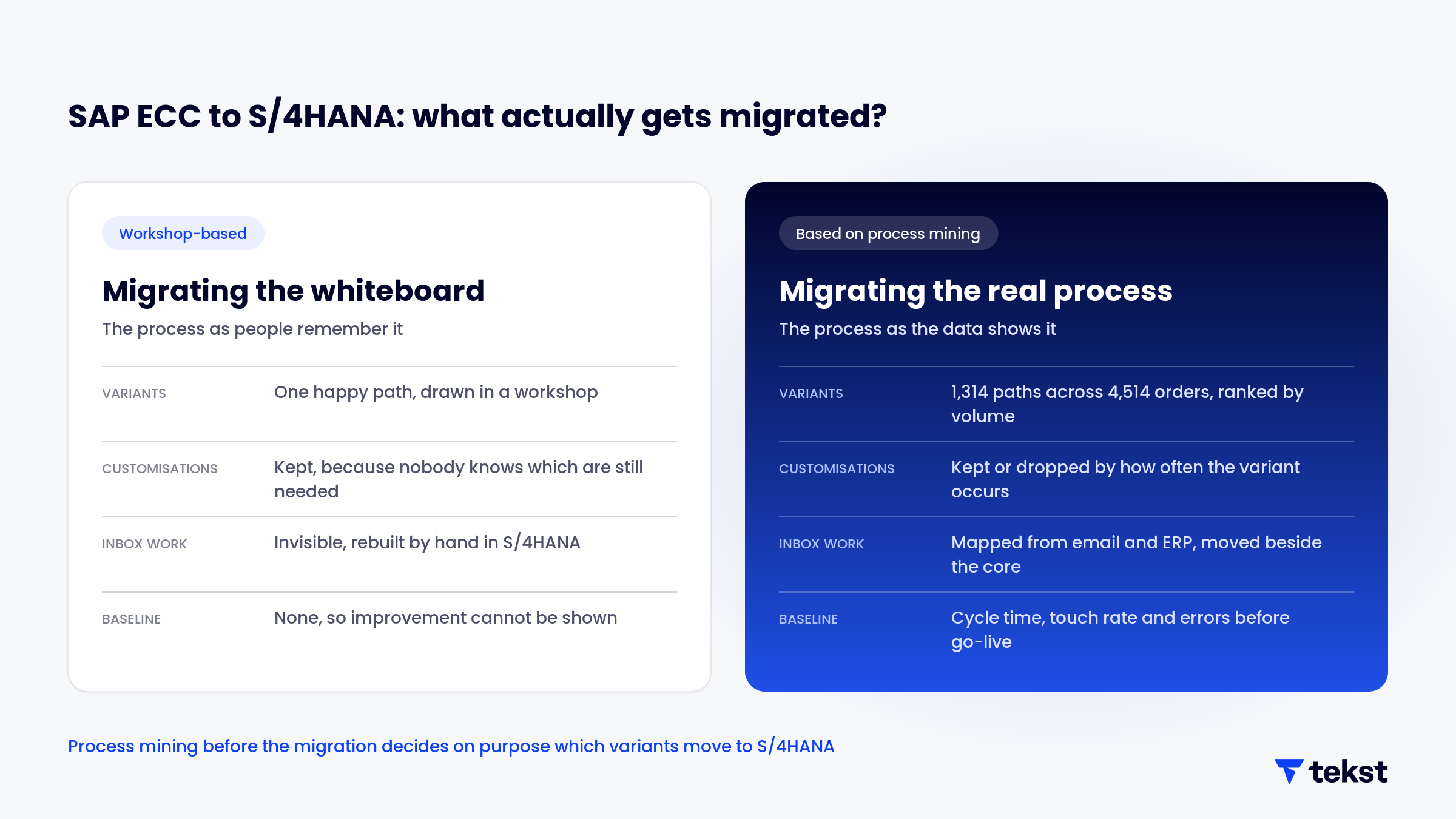
- How many variants are there, and which ones matter? In the anonymised order desk audit mentioned above, 4,514 orders followed 1,314 paths. A handful carry most of the volume. Many of the rest are workarounds that should not survive the move.
- Which customisations are still earning their keep? If a custom transaction serves a variant that occurs twice a year, that is a candidate for the standard. If it serves a third of all orders, it needs a plan.
- Where is the manual work? Rework loops, handovers and waiting times show where the new system has to perform better than the old one, and where automation pays off first.
- What is the baseline? Volumes, cycle times and touch rates before go-live are the only way to show afterwards whether the migration improved the process or just moved it.
Automated process discovery does this without months of interviews. Full process visibility is typically possible in under 10 days, which matters when the deadline is already on the calendar.
Process mining does not replace the fit-to-standard work of a migration. It gives that work real numbers to argue with.
The processes ECC never sees
Process mining on ERP data has one limit, and it matters for an ERP migration. It reads event logs, and an event log only starts when someone types the work into SAP.
A large part of order-to-cash happens before that moment. Orders arrive as PDF attachments, spreadsheets and lines in the body of an email, which is why AI order processing starts in the inbox rather than in the ERP. Customers send changes to orders already placed, ask for delivery dates and chase confirmations. At Mitsubishi Chemical Group, 60% of orders required manual entry, taking up 20% of inside sales time, while the template-based OCR in place handled only 4% of orders. In the order desk audit, every time an order arrived without complete technical data, the correction round between inbox and SAP added more than 14 hours.
None of that appears in an ECC event log. If a migration only analyses what is in ECC, the inbox side of the process stays invisible, and it gets rebuilt in S/4HANA exactly as before: by people copying data from one screen into another.
This is the gap process intelligence fills. It reads communication data and system data together, links every email and attachment to the order or case it belongs to, and builds one picture of the process from the first message to the last ERP update. For a migration, that means the process being redesigned is the whole process, not just the part SAP already knows about.
Keeping order intake stable during the move
Order intake is where an ERP change reaches customers first. If the team that enters orders has to learn new screens, new transactions and new master data structures while orders keep arriving, errors and delays land with customers. Quote-to-cash (Q2C), often used interchangeably with order-to-cash (O2C), is also the process where most of those orders, changes and questions arrive by email.
One way to lower that risk is to keep order capture out of the ERP core. A layer in front of the ERP reads the order email, extracts the data, validates it against customer and product master data and writes it into the ERP, while uncertain cases go to a person for approval. This is how quote-to-cash automation works when it sits in front of SAP rather than inside it. Tekst describes its role as the last checkpoint before SAP.
The idea follows the same logic as SAP's own clean core principle: keep the standard core free of invasive customisations, and build what is specific to the business beside it. Tekst connects to SAP S/4HANA through SAP BTP Cloud Integration, outside the core. The order logic that used to live in custom ECC code, or in the heads of the order desk, can live in that layer instead.
The result is less to rebuild during the migration, and an order desk that keeps working the same way while the system behind it changes. At Dossche Mills, AI classification of incoming customer service email reached over 95% accuracy across its EMEA mailboxes.
A checklist for operations teams before 2027
- Confirm your exposure. Which ECC systems and enhancement packages do you run, and which support date applies?
- Map how order-to-cash actually runs. From ERP data and from the inbox, with real volumes, variants and exceptions.
- Separate the variants you need from the workarounds. Every variant you keep has to be built, tested and maintained in S/4HANA.
- Decide what stays standard and what lives beside the core. Use the data to argue the case, not the loudest voice in the workshop.
- Set a baseline. Cycle time, touch rate and error rate per process, measured before go-live.
- Plan order intake for the cutover. Decide how orders, changes and customer questions will be handled while the system changes underneath.
- Measure again after go-live. Compare against the baseline, and fix what got worse before it becomes the new normal.
Where to start with SAP ECC end of life
Start with one process that matters to customers and runs through the inbox as much as through SAP. For most companies that is order-to-cash. Map how it really runs before anyone decides what S/4HANA should look like.
The 2027 deadline is fixed. What moves to S/4HANA is not. A migration built on the whiteboard carries the whiteboard's blind spots into the next twenty years. A migration built on process data starts with the 1,314 paths, and decides on purpose which ones to keep.